• Skip to main content

MOOSE MARKETS

INVESTING THE CANADIAN WAY

  • Dividend Investing
    • Best Canadian Stocks to Buy in 2025
    • Dogs of the TSX – Beat The TSX! 2025
    • Canoe Income Fund
    • Canadian Banks Ranking 2025
    • Canadian Dividend Rock Stars List
    • Canadian Dividend Aristocrats 2025
    • Buy and Hold Forever Stocks
  • REITs
    • Canadian REITs Beginner’s Guide
    • Best Monthly REITs 2025
  • How To
    • Income Products at Retirement
    • 4 Budgets of Retirement
    • Create a Cash Wedge at Retirement
    • 5 Questions for a Confident Retirement
  • ETFs
    • Guide to ETF Investing
  • Portfolio Strategies
    • Canadian Depositary Receipts (CDRs)
    • Building an Income Portfolio – Made Easy
  • Newsletter
  • Podcast

blog

The Canadian Dividend King That Powers Portfolios

Some companies chase growth; others define stability. Fortis falls squarely in the latter camp — a true Dividend King with over 50 consecutive years of dividend increases, making it one of the most reliable income plays in North America.

While it may not grab headlines with flashy innovation, this utility powerhouse has quietly powered millions of homes — and countless portfolios — with the same steady rhythm for half a century.

If you’re building a portfolio to last, Fortis earns a spot on your shortlist right alongside the names featured in our Canadian Forever Stock Selection.

Business Model: Regulated Power, Predictable Growth

Fortis (FTS.TO) is one of North America’s largest regulated utility companies, serving over 3.5 million customers across Canada, the U.S., and the Caribbean. Its operations span electricity and natural gas distribution, transmission infrastructure, and renewable energy projects.

Roughly 99% of its earnings come from regulated operations, giving the company one of the most stable revenue bases in the market. Major subsidiaries such as ITC Holdings (U.S.), UNS Energy (Arizona), and FortisBC provide geographic and regulatory diversification.

This structure provides reliable cash flows, allowing Fortis to fund steady dividend growth and a robust C$26 billion capital plan through 2028.

Why Invest in Fortis, as found in its Q2 2025 Investors Presentation.

Investment Thesis: Powering Ahead with Predictability

Bull Case: A Model of Consistency

Fortis has mastered the art of slow, steady, and sustainable growth. Its regulated revenue model offers unmatched visibility into future earnings, while its ongoing capital investments fuel long-term expansion. The utility plans to grow its rate base by 6.5% annually through 2028, driven largely by investments in its U.S. transmission network (ITC) and renewable energy initiatives.

The company’s ability to deliver 4–6% annual dividend growth through 2029 underscores its commitment to shareholders. Fortis has raised its dividend for 51 consecutive years, placing it in the rare category of Canadian Dividend Kings.

Growth drivers include:

  • Large-scale grid and transmission expansion in the U.S. Midwest and Canada
  • Transition of coal assets to natural gas and renewable generation
  • Strategic investments in offshore wind and renewable natural gas
  • Inflation-linked rate base adjustments ensure cash flow protection

Fortis remains one of the few utilities offering steady earnings growth, inflation resilience, and reliable dividend compounding — all wrapped in a conservative, defensive package.

Bear Case: Regulated Stability Comes with Limits

While Fortis provides safety and predictability, it isn’t immune to headwinds. The company’s heavy reliance on debt-funded capital projects makes it sensitive to rising interest rates and financing costs. Approximately one-third of its current capital plan is funded through debt, a structure that works best in stable-rate environments.

Additionally, currency risk is real — with roughly 60% of earnings generated in the U.S., fluctuations in the CAD/USD exchange rate can impact results.

The regulated nature of its business also means limited upside: returns are capped by rate decisions from regulators. While this reduces volatility, it also constrains potential outperformance compared to faster-growing peers like Hydro One or Emera.

Finally, environmental and policy shifts — particularly around carbon reduction — could pressure Fortis to accelerate its transition spending faster than planned, straining capital budgets.

Latest News: Staying on Plan and On Track

On August 8, 2025, Fortis reported a solid quarter with EPS up 13% year-over-year, driven by continued execution of its capital plan and strong regulatory outcomes.

The company reaffirmed its C$26 billion five-year capital plan, including:

  • Converting 793 MW of coal generation at TEP’s Springerville station to natural gas by 2030
  • Achieving a coal-free portfolio by 2032
  • Growing its regulated rate base from US$39B (2024) to US$53B (2029) — a 6.5% CAGR

With $2.9 billion in capex deployed in the first half of 2025, Fortis remains firmly on schedule and continues to target annual dividend growth of 4–6% through 2029.

The Dividend Triangle in Action: Stability You Can Count On

Fortis (FTS.TO) 5-year dividend triangle.

Fortis’s Dividend Triangle — the combination of revenue, earnings, and dividend growth — demonstrates remarkable consistency over the past decade.

  • Revenue: Steady growth driven by rate base expansion
  • Earnings per Share: Reliable increases supported by predictable cash flows
  • Dividend: A 51-year streak of increases — the gold standard of dependability

Final Words: The Dividend King of Consistency

Fortis doesn’t aim to surprise the market — it aims to outlast it. With a proven management team, strong regulatory relationships, and an unbroken dividend growth record stretching over five decades, this utility remains a cornerstone holding for dividend investors seeking peace of mind.

It’s the kind of stock that may never dominate headlines, but it will quietly power your portfolio through any market cycle.

Want More Dividend Rock Stars?

If you like dependable names like Fortis, don’t miss our Dividend Rock Star List — your guide to the best Canadian companies combining growth, stability, and reliable income for the long haul.

Red star.

The Best Canadian Energy Companies

Energy stocks are not typically my go-to for a dividend growth portfolio. Their cash flows swing with commodity prices, and dividend cuts can come faster than oil spills when markets turn. Yet, despite that volatility, Canada’s energy sector holds a few bright spots worth a closer look.

Some of these companies have learned to thrive in a world that no longer rewards boom-or-bust cycles. They’ve adapted with stronger balance sheets, better capital discipline, and a growing focus on shareholder returns. Whether through pipelines, oil sands, or industrial equipment, these players demonstrate that dependable cash flow can still be found in the energy patch — if you know where to look.

4. Enbridge (ENB.TO)

The Backbone of North American Energy Flow

Investment Thesis
Enbridge isn’t an oil producer — it’s the toll road that energy flows through. Its vast pipeline network transports roughly 70% of Canada’s crude oil and a large portion of its natural gas. Thanks to long-term take-or-pay contracts (many lasting over two decades), Enbridge enjoys a predictable cash flow largely independent of commodity prices.

Following its merger with Spectra Energy, Enbridge expanded into natural gas transmission, which now makes up nearly half of earnings. The company also operates a growing portfolio of renewable energy assets, positioning it to play a role in the energy transition. Management targets 7–9% annual EBITDA growth through 2026, underpinned by recent U.S. gas utility acquisitions.

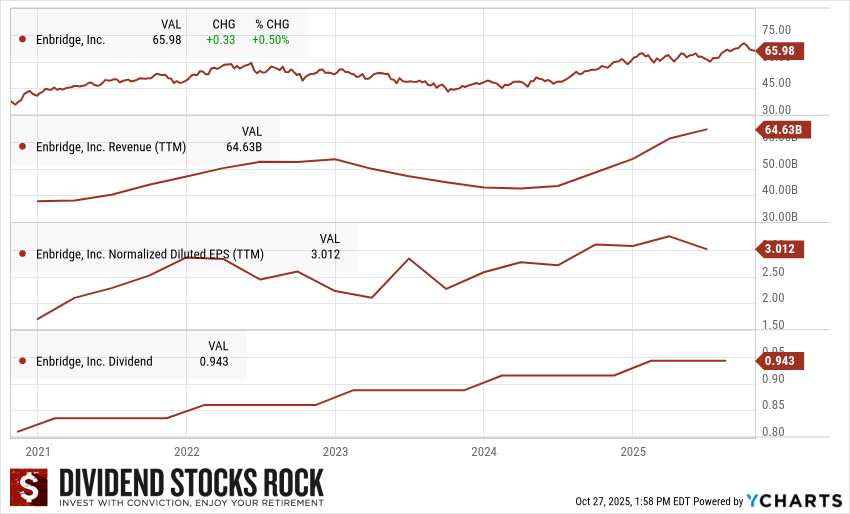
Enbridge (ENB.TO) 5-year dividend triangle chart.

Potential Risks
Enbridge’s biggest challenge is its balance sheet. With over $100 billion in long-term debt, rising interest rates and regulatory hurdles could strain cash flow. Environmental opposition and project delays remain constant risks. While the company’s infrastructure is essential, its growth runway may narrow without further acquisitions or policy tailwinds.

Unlock More Dividend Growth Picks

If you want more hand-picked dividend growers across industries, grab our Dividend Rock Star List.Red star.

It features around 300 stocks with complete Dividend Safety Scores, growth projections, and buy lists tailored for retirement portfolios.

Most importantly, it is the ONLY list using the Dividend Triangle as its foundation.

3. TerraVest Industries (TVK.TO)

The Small-Cap Engine Powering Industrial Energy

Investment Thesis
TerraVest is a rare gem among smaller Canadian industrials. The company designs and manufactures specialized equipment for energy, transportation, and infrastructure markets — making it a hybrid between an energy supplier and a diversified manufacturer.

Its growth strategy leans heavily on acquisitions, expanding product lines, and market reach while maintaining disciplined execution. Recent deals like Advance Engineered Products and Highland Tank have boosted both scale and profitability. With recurring demand for essential infrastructure products, TerraVest’s cash flows tend to hold up even when oil prices drop.

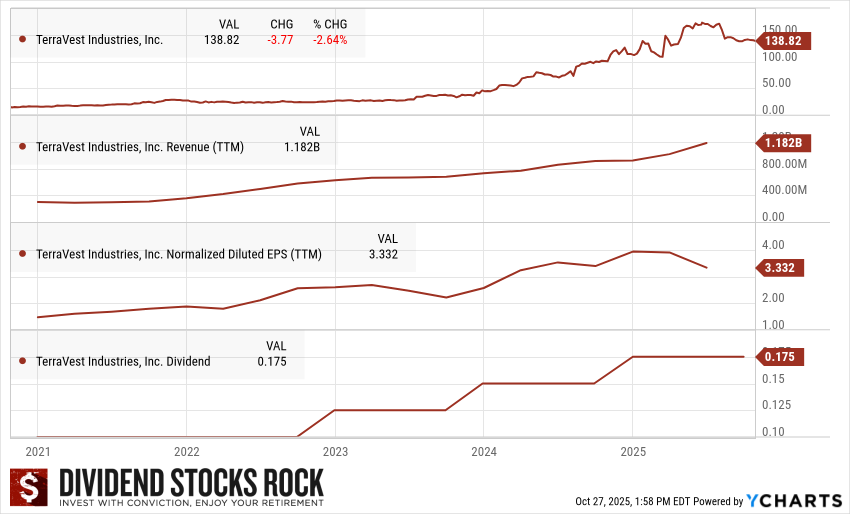
TerraVest Industries (TVK.TO) 5-year dividend triangle chart.

Potential Risks
As a small-cap, TerraVest carries more volatility and execution risk. Integration challenges from rapid acquisitions can pressure margins, as seen in 2025 when financing costs weighed on earnings despite strong revenue growth. Investors should expect more fluctuation here than from larger peers.

2. Imperial Oil (IMO.TO)

A Steady Hand Backed by Exxon

Investment Thesis
Imperial Oil brings stability to an often-unstable sector. Its vertically integrated structure — spanning upstream, refining, and retail — provides balance across market cycles. With Exxon Mobil as a majority shareholder, Imperial gains access to world-class technology, research, and capital discipline.

Refining operations and over 2,000 Esso-branded stations offer steady cash flow when crude prices slump. Meanwhile, oil sands operations like Kearl and Cold Lake deliver scale and longevity. Recent investments in carbon capture and clean fuel initiatives show Imperial’s pragmatic approach to the energy transition.

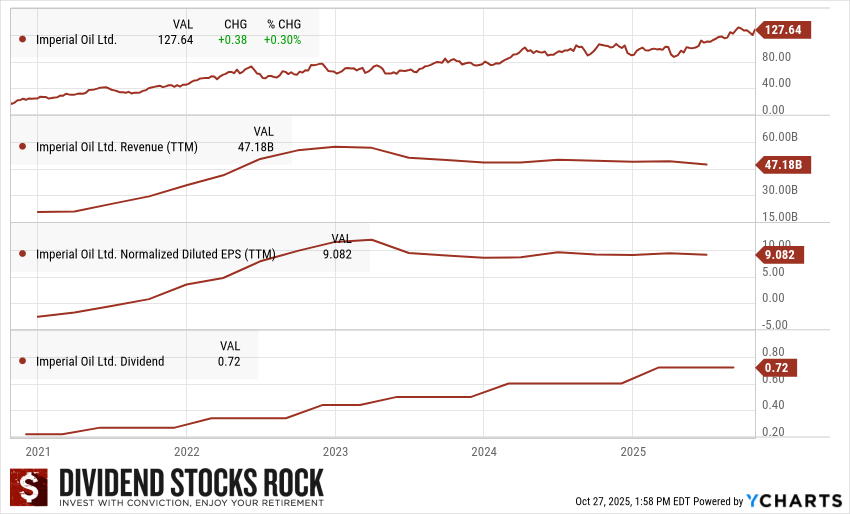
Imperial Oil (IMO.TO) 5-year dividend triangle chart.

Potential Risks

Imperial’s oil sands exposure keeps it tethered to heavy crude prices and environmental scrutiny. Sustained low oil prices would strain its upstream cash flow, while delays in emission-reduction projects could hurt competitiveness.

1. Canadian Natural Resources (CNQ.TO)

A Cash Flow Machine in a Cyclical World

Investment Thesis
Canadian Natural Resources (CNQ) stands out as one of Canada’s most disciplined and diversified producers. Its combination of long-life, low-decline oil sands assets and conventional oil and gas operations gives it a unique ability to generate free cash flow even when crude prices weaken. With a breakeven WTI near $35 per barrel, CNQ has consistently outperformed peers during downturns.

The company’s strategy is refreshingly straightforward — produce efficiently, reinvest wisely, and return excess cash to shareholders. In 2025, production is expected to rise 13% year over year, driven by new projects and acquisitions, such as Chevron’s Alberta assets. Management’s proven counter-cyclical approach — investing when others retreat — has paid off in both growth and resilience.

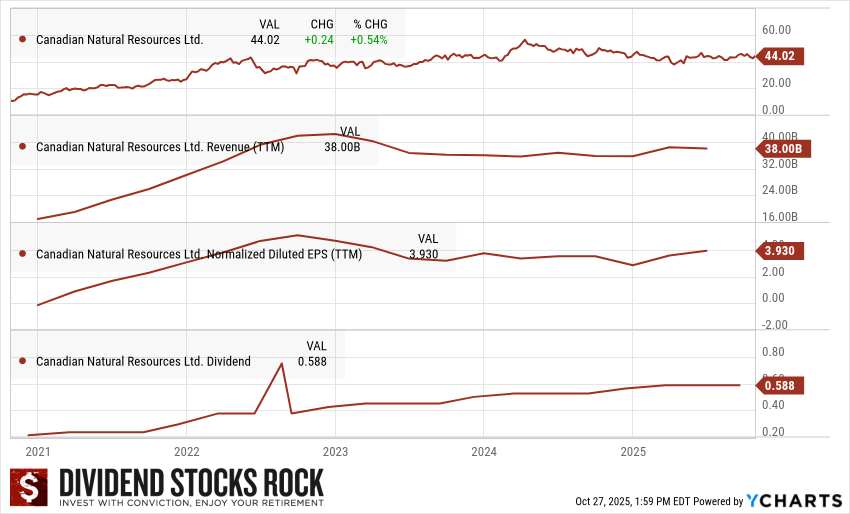
Canadian Natural Resources (CNQ.TO) 5-year dividend triangle chart.

Potential Risks
CNQ’s profitability remains tied to commodity prices. Environmental and regulatory headwinds, particularly in Alberta, could limit expansion or increase compliance costs. Its capital-intensive oil sands operations, while efficient, are exposed to carbon pricing and pipeline constraints that could erode margins.

Balancing Risk and Reward in the Energy Sector

Canadian energy companies have come a long way from their boom-and-bust past. The best names today combine scale, efficiency, and diversification — essential traits for thriving in a decarbonizing world. Still, this remains a cyclical sector, where patience and timing matter.

For dividend investors, the key isn’t chasing the highest yield, but finding sustainable growth supported by operational discipline. CNQ and Imperial deliver that through scale and balance; TerraVest brings agility and niche strength; and Enbridge provides reliable cash flow through its infrastructure dominance.

If you’re looking to add exposure to Canada’s energy sector, these four companies represent the most solid mix of stability, growth potential, and dividend dependability available today. Just remember — even the steadiest oil stock can wobble when prices swing.

Find More Dividend Rock Stars

Want to discover more high-quality dividend growers like these?Red star.

Grab your copy of our Dividend Rock Star List, featuring around 300 stocks screened for dividend safety, growth potential, and long-term reliability.

Download your free Dividend Rock Star List here

Turning Trash into Steady Treasure

Waste might not be glamorous, but it’s one of the most reliable businesses out there. In good times or bad, people still generate garbage — and someone has to collect it. That simple reality has made the waste management industry a quietly powerful source of recurring revenue and growing dividends. Among the sector’s leaders, one company stands out for its disciplined growth, smart acquisitions, and focus on steady returns.

A Fortress Built from Waste

Waste Connections (WCN.TO) operates a vast network of landfills, transfer stations, and collection routes across the U.S. and Canada, serving roughly nine million residential, commercial, and industrial customers. It collects, transports, and disposes of non-hazardous solid waste while also managing recycling and renewable fuel recovery programs.

What makes the company unique is where it operates — primarily in secondary and rural markets. These regions face less competition and lower regulatory friction than dense urban areas, allowing for superior pricing flexibility and stronger margins.

Its integrated model — from curbside pickup to landfill disposal — provides both efficiency and pricing control. Add to that long-term municipal and industrial contracts, and you get a business that hums along through economic ups and downs.

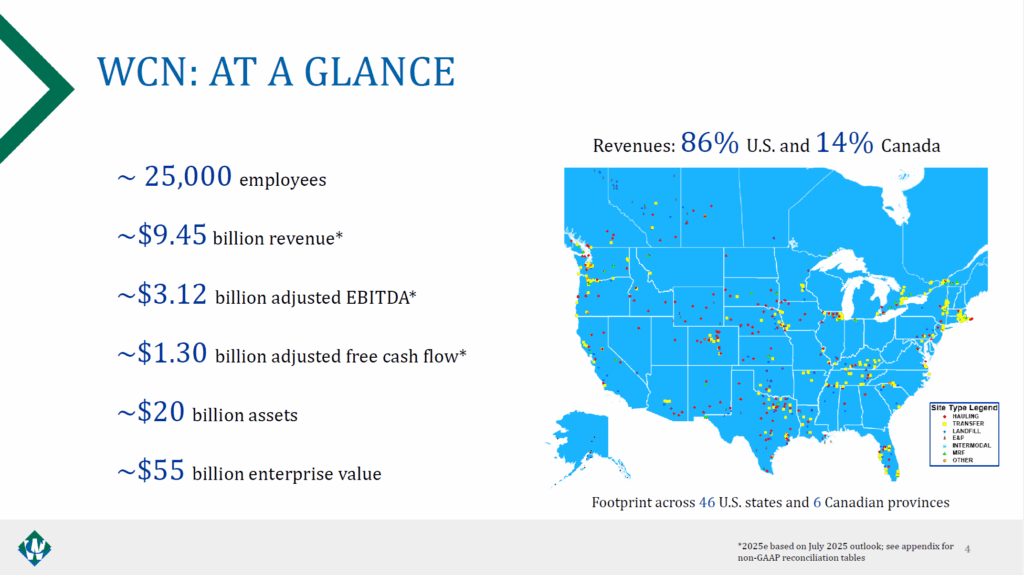
Waste Connections (WCN.TO) at a glance, from its Q3 2025 Investor Presentation.

Investment Thesis: Built to Withstand the Cycle

Bull Case — Consistency You Can Count On

This is the kind of company dividend investors love: predictable, cash-generative, and built to last. Waste Connections benefits from steady demand, high switching costs, and barriers to entry that few industries can match.

Playbook:
The company generates most of its revenue from recurring waste collection and disposal services. Its strategy is to expand organically while acquiring smaller operators, integrating them into its efficient network. By controlling every step of the waste stream, it captures value others miss — from landfill tipping fees to recycling recovery.

Growth Vectors:

  • Acquisitions remain the backbone of growth. The purchase of Secure Energy Services’ Canadian disposal assets boosted both revenue and margin potential.
  • Core pricing power is another strength — solid waste pricing rose 6.6% year-over-year in the latest quarter.
  • Recycling and environmental services are emerging growth levers as the company expands into renewable fuels and materials recovery.
  • Strong cash generation supports continued investment and dividend increases, with adjusted free cash flow projected near $1.3 billion this year.

Economic Moat:
The moat here is real and durable. Landfill scarcity and regulatory hurdles make it extremely difficult for new competitors to enter. Once contracts and routes are established, customer churn is minimal. Waste Connections can raise prices above inflation without losing volume — a rare feat in any industry.

Bear Case — Even Strong Businesses Have Limits

Despite its resilience, this isn’t a risk-free story. The waste management sector carries its own operational and environmental challenges.

Business Vulnerabilities:
The company’s acquisition-heavy model demands constant integration. As industry consolidation continues, finding attractively priced targets will get tougher. Rising labor and equipment costs could also erode margin gains over time.

Industry & Market Threats:

  • Recycling volatility remains a headwind — commodity price swings can cause sharp revenue fluctuations.
  • Regulatory pressure is increasing, particularly as cities push for reduced landfill usage.
  • A slowdown in commercial and industrial activity could weigh on waste volumes if the economy softens.

Competitive Landscape:
While the company enjoys a strong position in smaller markets, larger peers like Waste Management (WM) and Republic Services (RSG) dominate urban centers and are expanding their sustainability initiatives. If governments tighten environmental standards or encourage municipal recycling, the competitive gap could narrow.

The ONLY List Using the Dividend Triangle

You may wonder how I find such high-quality dividend stocks.

I handpick companies with a strong dividend triangle (revenue, earnings, and dividend growth trends) and make sure I understand their business model. While this may seem too simple, two decades of investing have shown me it is reliable.Red star.

While many seasoned investors also use these metrics in their analysis, no one has created a list based on them before. This is exactly why I created The Dividend Rock Stars List.

The Rock Stars List isn’t just about yield—it’s built using a multi-step screening process to ensure the highest-quality dividend stocks. You can read more about it or enter your name and email below to get the instant download in your mailbox.

Latest News — Another Quarter of Steady Gains

August 8, 2025: The company reported another solid performance, with revenue up 7% and EPS up 4.7%. Core pricing in solid waste services increased 6.6%, leading to roughly 70 basis points of margin expansion.

Management reaffirmed full-year 2025 guidance:

  • Revenue: ~$9.45 billion
  • Adjusted EBITDA: ~$3.12 billion (≈33% margin)
  • Adjusted Free Cash Flow: ~$1.30 billion
  • CapEx: $1.2–$1.25 billion

Those numbers highlight the beauty of the model — dependable growth, disciplined spending, and resilient profitability even amid inflation and volatile commodity trends.

The Dividend Triangle in Motion

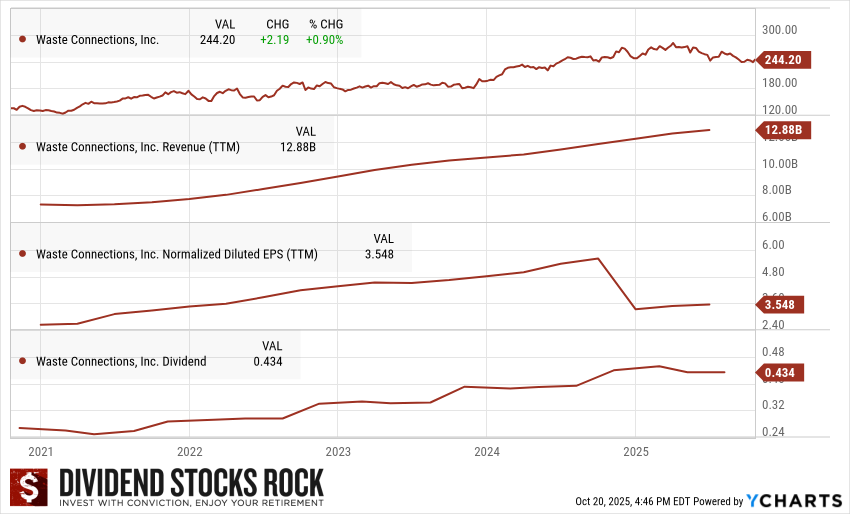
Waste Connections (WCN.TO) 5-Year Dividend Triangle chart.

Waste Connections may not boast the highest yield, but it’s a classic dividend grower. Its consistent pricing gains and cash flow discipline translate into sustainable, long-term dividend growth.

  • Revenue: $12.9 billion (TTM), rising steadily year after year.
  • Earnings per Share (EPS): $3.55 TTM, rebounding from recent acquisition-related costs.
  • Dividend: $0.434 per share, continuing its climb with a payout ratio comfortably below 25%.

The company’s dividend may look modest, but its growth record is strong, with double-digit hikes common in recent years. Investors can expect more of the same as earnings and cash flow expand.

Final Take — The Steady Hand in a Messy World

In an unpredictable market, it’s refreshing to find a company where performance isn’t tied to consumer confidence or economic cycles. Waste Connections turns necessity into opportunity, combining a recession-resistant business with disciplined management and reliable dividend growth.

Its focus on smaller markets, strong pricing power, and steady free cash flow give it a long runway for shareholder returns. This isn’t a flashy story — it’s a dependable one. And sometimes, that’s exactly what a dividend growth portfolio needs.

Find Other Buy and Hold Forever Stocks: Download the Dividend Rock Stars List

This dividend stock list is updated monthly. You will receive the updated version every month by subscribing to our newsletter. You can download the list by entering your email below.

This isn’t just a list of high-yield stocks—it’s a handpicked selection of Canada’s best dividend growth stocks backed by detailed financial analysis.

Red star.

  • Monthly updates
  • Full dividend safety ratings
  • 10+ Metrics with filters

Enter your email to get the latest Canadian Dividend Rock Stars List now!

Copyright © 2025 · Moose Markets