• Skip to main content

MOOSE MARKETS

INVESTING THE CANADIAN WAY

  • Dividend Investing
    • Best Canadian Stocks to Buy in 2025
    • Dogs of the TSX – Beat The TSX! 2025
    • Canoe Income Fund
    • Canadian Banks Ranking 2025
    • Canadian Dividend Rock Stars List
    • Canadian Dividend Aristocrats 2025
    • Buy and Hold Forever Stocks
  • REITs
    • Canadian REITs Beginner’s Guide
    • Best Monthly REITs 2025
  • How To
    • Income Products at Retirement
    • 4 Budgets of Retirement
    • Create a Cash Wedge at Retirement
    • 5 Questions for a Confident Retirement
  • ETFs
    • Guide to ETF Investing
  • Portfolio Strategies
    • Canadian Depositary Receipts (CDRs)
    • Building an Income Portfolio – Made Easy
  • Newsletter
  • Podcast

best Canadian dividend stocks

Built on Trust, Powered by Wellness

When you look at steady dividend growth, you expect to find utilities, pipelines, or maybe a telecom. But every now and then, a consumer-facing brand breaks into the conversation by doing something rare: growing consistently, expanding globally, and becoming a staple in households. This business fits that profile. It’s not cyclical like energy, nor structurally challenged like traditional retail. Instead, it sells products people buy month after month, often for years.

And while the market has punished many small caps over the past two years, this name has quietly continued expanding its reach, especially in high-growth international markets. It’s also part of the Canadian Dividend Aristocrats, reinforcing its commitment to long-term dividend growth.

If you’re looking for a growth-oriented dividend payer with a strong brand and global ambitions, this one deserves a place on your radar.

How This Wellness Machine Works

Jamieson Wellness (JWEL.TO) operates a dual-segment model that balances brand strength with manufacturing scale. Its flagship Jamieson Brands division—representing roughly 85% of total revenue—includes its well-known vitamins, minerals, and supplements sold across Canada and over 50 international markets. This segment is the engine of the company: strong brand trust, high margins, and expanding global distribution.

Jamieson Wellness Global Brands from its Investors Presentation.

The Strategic Partners segment handles contract manufacturing for third parties. This adds volume, improves capacity utilization in its Canadian and U.S. facilities, and provides revenue diversification. While lower-margin, it supports the company’s manufacturing scale and helps spread fixed costs across more units.

Across both segments, Jamieson sells everything from multivitamins to immunity blends, sports nutrition, probiotics, and beauty-from-within products. Formats range from gummies to chewables to powders, keeping the portfolio modern and competitive with global players.

Why This Brand Has Staying Power

Jamieson has carved out a rare position in Canadian markets: a trusted consumer brand with accelerating international growth. For investors, this translates into a company that combines steady domestic demand with high-growth expansion abroad—especially in China and the U.S.

When the Formula Really Works

Jamieson’s biggest advantage is its brand equity, built over nearly a century and reinforced through quality-first marketing. This brand trust gives the company pricing power, especially in Canada where it dominates shelf space. Internationally, momentum is building quickly. China—where the wellness category is booming—delivered over 60% growth last quarter due to strong digital marketing and improved e-commerce presence. The company’s U.S. brand, Youtheory, also posted double-digit growth.

Another compelling part of the story is consistent top-line growth, typically in the high single digits to low double digits. Management is reinvesting heavily in marketing and distribution, which has temporarily compressed margins. But for long-term investors, this is exactly the type of reinvestment you want to see during a global expansion cycle.

Finally, the recent valuation reset has brought Jamieson back into a reasonable range for investors who prefer growth at a fair price rather than chasing momentum at the top.

Where the Formula Can Break Down

Jamieson’s EPS track record has not been as smooth as its revenue. Margin pressure, driven by reinvestment and cost inflation, has kept earnings growth uneven. Management’s 2025 EPS guidance sits below analyst expectations, reflecting near-term pressure.

The company also operates in a heavily regulated industry. Changes in labeling rules, product categories, or natural health product regulations can create temporary disruptions. International markets add further risk through foreign exchange volatility and evolving regulatory frameworks.

While the brand is dominant in Canada, Jamieson faces tough competition abroad from global giants like Haleon, Kenvue, and Glanbia. Winning shelf space, protecting margins, and maintaining product trust in new regions will require continuous investment and flawless execution.

Latest News: A Quarter Driven by Global Growth

On November 19, 2025, Jamieson delivered a strong quarter with revenue up 13% and EPS up 11%, driven by powerful momentum in its branded segment.

Key highlights:

  • Jamieson Brands +16.5%, led by strong performance across Canada, China, and international markets
  • Canada +4%, supported by effective marketing and product innovation
  • China +63%, thanks to stronger digital presence and high-performing online campaigns
  • Youtheory +16.8% in the U.S. via e-commerce and retail expansion
  • International markets +19.3%
  • Strategic Partners -11.2%, reflecting contract delays due to trade and tariff volatility

Overall, the branded business continues to carry the story.

The Dividend Triangle in Action: Growth with a Long Runway
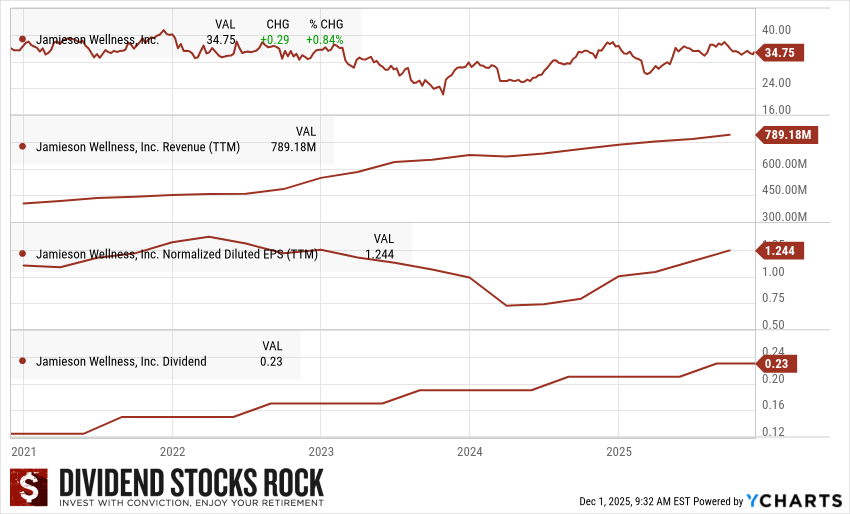
Jamieson Wellness (JWEL.TO) 5-year Dividend Triangle chart.
Jamieson Wellness (JWEL.TO) 5-year Dividend Triangle chart

Jamieson’s dividend triangle tells the story of a company in expansion mode, not a mature slow-growth payer.

Revenue:
Revenue has grown steadily and at an impressive pace, reflecting strong domestic demand and accelerating international expansion.

Earnings per Share:
EPS has been bumpier, but the long-term trend is upward as investments begin converting into higher-margin branded sales.

Dividend:
The dividend continues to grow responsibly, supported by solid cash flow generation and the company’s commitment to maintaining its Dividend Aristocrat status.

Final Thoughts: A Growth-Oriented Dividend Payer Worth Watching

Jamieson is not your traditional defensive health stock—nor is it a commodity-based value play. It sits at the intersection of brand strength, global expansion, and health/wellness tailwinds. Short-term margin noise may keep the stock volatile, but long-term investors willing to ride the expansion curve could be well rewarded.

If you’re building a dividend portfolio with a bit of growth punch, this is one of the few small caps in Canada worth following closely.

Your Next Step: Get the Dividend Rock Star List

If you’re looking for high-quality dividend growers with proven business models and strong track records, make sure you download the Dividend Rock Star List—your shortcut to f

Red star.

iltering out the noise and focusing on the best stocks available in Canada and the U.S.

👉 Get the Dividend Rock Star List here.
A Freight Machine Built for Tough Cycles

The transportation sector is notoriously cyclical, but some businesses learn to make volatility work in their favor. This is one of the rare freight operators that consistently comes out of downturns stronger than it went in. It expands when others retreat, improves margins when competitors are scrambling, and uses every cycle—good or bad—to upgrade its network and strengthen its long-term positioning.

For dividend investors willing to stomach short-term turbulence, this is one of the most compelling ways to gain exposure to North American logistics. It’s not smooth, and it’s not gentle—but over a full market cycle, the results tend to reward those who stay on board.

How the Business Works

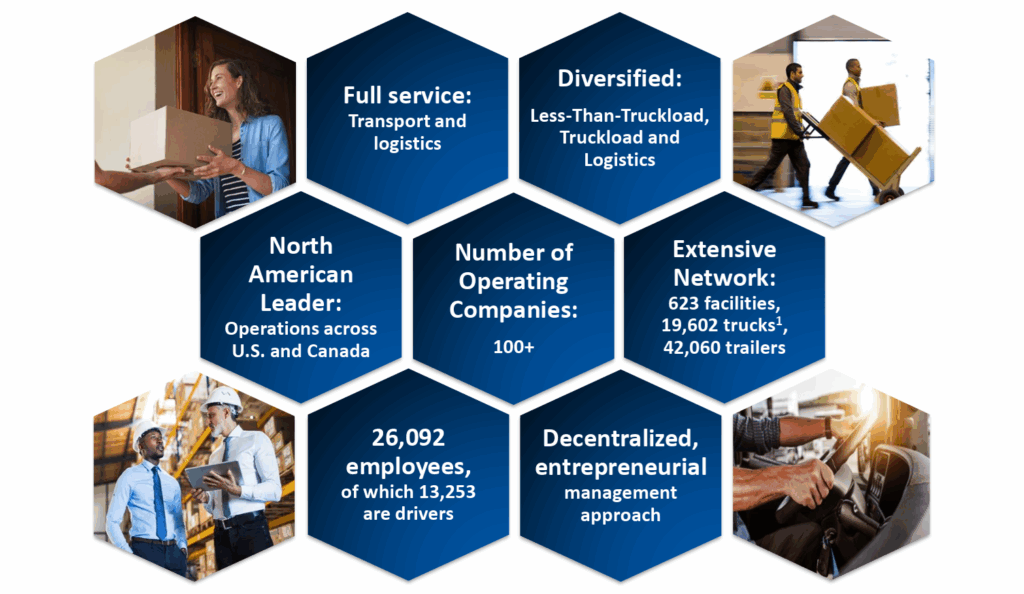
TFI International (TFII.TO) operates across three major segments:

  • Less-Than-Truckload (LTL) — Pickup, consolidation, and delivery of small shipments.
  • Truckload (TL) — Full-load direct transport using vans, flatbeds, tank containers, and dedicated fleets.
  • Logistics — Asset-light brokerage, freight forwarding, and transportation management.

The company runs an extensive network across Canada, the U.S., and Mexico, serving industrial, retail, construction, and e-commerce customers. TFI uses a hybrid model—owning assets where it provides an advantage and keeping things asset-light in brokerage and logistics—to maintain flexibility during economic swings.

TFI International Who We Are, from its Q3 Presentation.


The Investment Thesis: Built to Scale, Built to Survive

TFI International has proven itself as one of the most disciplined operators in North American transportation. Over 70% of revenue now comes from the U.S., giving the company exposure to the largest trucking market in the world and to industries like manufacturing, construction, and e-commerce.

TFI’s strength lies in acquisition mastery. The 2021 purchase of UPS Freight was transformational—TFI cut operational waste, improved pricing discipline, and significantly expanded margins. The more recent acquisition of Daseke strengthened its presence in flatbed trucking, a segment tightly linked to industrial and infrastructure activity.

TFI’s network density, cost discipline, and ability to pivot during downturns give it a durable competitive advantage. Even though trucking is cyclical, TFI continuously emerges stronger from each downturn—a rare quality in the transportation sector.

Bull Case Summary

  1. A North American Leader With Real Scale

TFI has grown into one of the largest trucking operators on the continent, with a deep footprint in Canada and the U.S. The company benefits from diversified end markets and a broad customer base, which helps soften the impact of industry cycles.

2. Acquisition Machine With a Proven Playbook

TFI’s greatest strength is its ability to take underperforming assets, streamline operations, and expand margins. The successful absorption of UPS Freight, and now Daseke, demonstrates that the company knows exactly how to extract value.

3. Margin Expansion Through Efficiency

Cost-cutting, fleet optimization, and asset-light operations in logistics allow TFI to maintain strong profitability even when freight volumes weaken. When markets recover, the margin leverage becomes even more compelling.

The Bear Case: Volatility Comes With the Territory

While TFI is a long-term winner, investors must be prepared for sharp short-term swings, especially during freight recessions.

The trucking industry is heavily tied to economic activity, and TFI’s results reflect that cyclicality. Higher fuel costs, labor shortages, and freight downturns can all pressure margins. The company’s rapid acquisition pace also creates integration risk—missteps could hurt returns.

In tougher quarters, TFI’s stock often reacts aggressively. When earnings disappoint, double-digit declines are not unusual. Investors need a strong stomach to stay the course.

  1. Highly Cyclical and Volatile

TFI is sensitive to industrial production, retail demand, and freight rates. When the economy slows, volumes fall quickly—and so does the stock price.

  1. Cost Pressures and Regulatory Risks

Fuel price spikes, driver shortages, and regulatory changes across North America can challenge profitability. Cross-border operations also add tariff and policy uncertainty.

  1. Acquisition-Driven Growth Can Create Integration Risk

TFI’s strategy requires constant deal-making. If the company overpays or struggles to integrate a major asset, it could disrupt margins and cash flow.

Latest News: Freight Recession Still Hitting Hard

TFI International delivered another difficult quarter as industry weakness continues.

Q3 Highlights:

  • Revenue: down 10%
  • EPS: down 24%
  • LTL revenue: $687M (-11%)
  • TL revenue: $684.1M (-7%)
  • Logistics revenue: $367.8M (-14%)
  • Margin pressure across all segments

Management expects Q4 EPS of $0.80–$0.90, citing lower truck-manufacturer deliveries and ongoing freight softness.

TFI remains focused on cost discipline, customer retention, and preparing for the next upcycle.

The Dividend Triangle in Action: Reliable — but Not Perfect

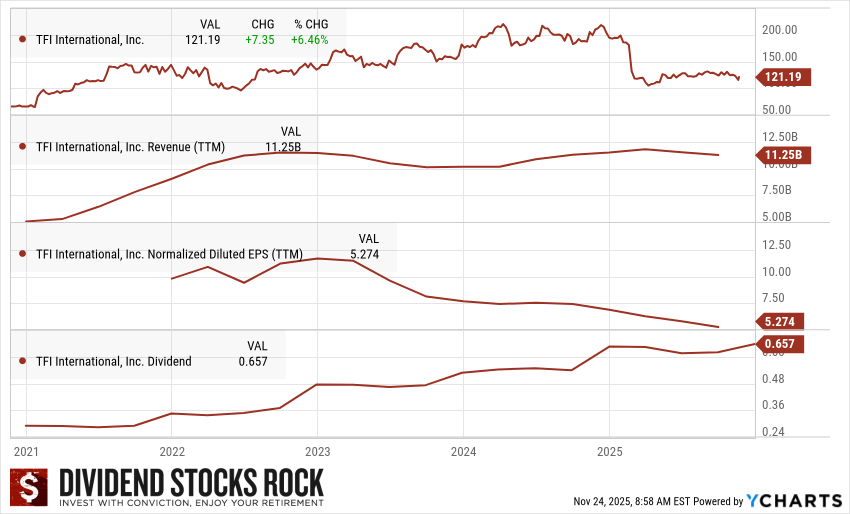
TFI International TFI.TO 5-year dividend triangle chart.

Revenue:
TFI’s revenue has grown meaningfully over the past five years, although it moves in cycles, reflecting the ebb and flow of North American freight demand.

Earnings per Share:
EPS has been more volatile than revenue, but over a full economic cycle it trends upward thanks to strong cost discipline, smart acquisitions, and margin improvements during recovery periods.

Dividend:
The dividend continues to climb steadily, supported by healthy free cash flow generation and a payout ratio that gives management room to keep raising the distribution even during slower freight years.

TFI is not a classic smooth dividend grower, but it is a high-performing compounder over time.

The ONLY List Using the Dividend Triangle

You may wonder how I find such high-quality dividend stocks.

I handpick companies with a strong dividend triangle (revenue, earnings, and dividend growth trends) and make sure I understand their business model. While this may seem too simple, two decades of investing have shown me it is reliable.

While many seasoned investors also use these metrics in their analysis, no one has created a list based on them before. This is exactly why I created The Dividend Rock Stars List.

Red star.


The Rock Stars List isn’t just about yield—it’s built using a multi-step screening process to ensure the highest-quality dividend stocks. You can read more about it or enter your name and email below to get the instant download in your mailbox.


Turning Trash into Steady Treasure

Waste might not be glamorous, but it’s one of the most reliable businesses out there. In good times or bad, people still generate garbage — and someone has to collect it. That simple reality has made the waste management industry a quietly powerful source of recurring revenue and growing dividends. Among the sector’s leaders, one company stands out for its disciplined growth, smart acquisitions, and focus on steady returns.

A Fortress Built from Waste

Waste Connections (WCN.TO) operates a vast network of landfills, transfer stations, and collection routes across the U.S. and Canada, serving roughly nine million residential, commercial, and industrial customers. It collects, transports, and disposes of non-hazardous solid waste while also managing recycling and renewable fuel recovery programs.

What makes the company unique is where it operates — primarily in secondary and rural markets. These regions face less competition and lower regulatory friction than dense urban areas, allowing for superior pricing flexibility and stronger margins.

Its integrated model — from curbside pickup to landfill disposal — provides both efficiency and pricing control. Add to that long-term municipal and industrial contracts, and you get a business that hums along through economic ups and downs.

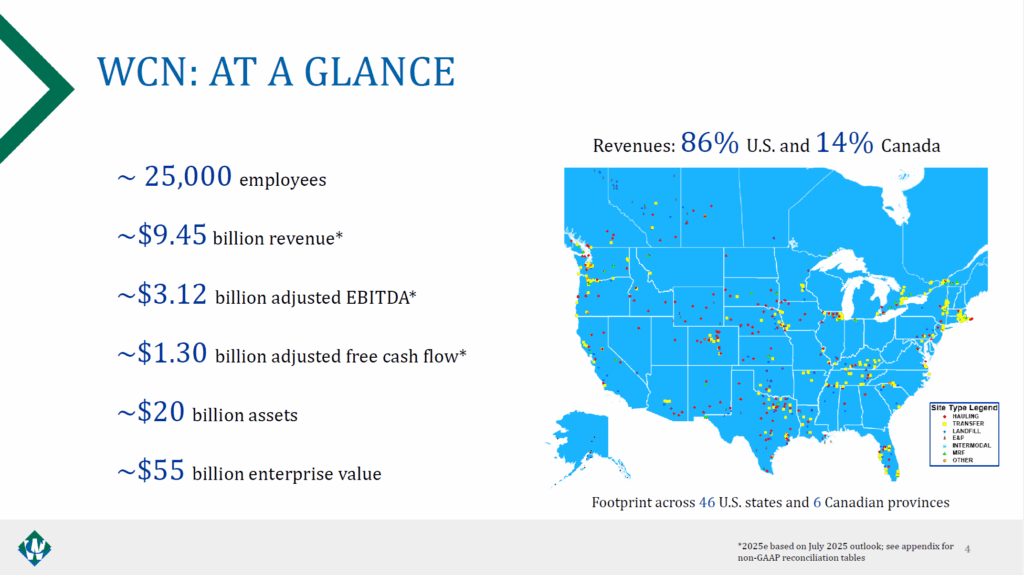
Waste Connections (WCN.TO) at a glance, from its Q3 2025 Investor Presentation.

Investment Thesis: Built to Withstand the Cycle

Bull Case — Consistency You Can Count On

This is the kind of company dividend investors love: predictable, cash-generative, and built to last. Waste Connections benefits from steady demand, high switching costs, and barriers to entry that few industries can match.

Playbook:
The company generates most of its revenue from recurring waste collection and disposal services. Its strategy is to expand organically while acquiring smaller operators, integrating them into its efficient network. By controlling every step of the waste stream, it captures value others miss — from landfill tipping fees to recycling recovery.

Growth Vectors:

  • Acquisitions remain the backbone of growth. The purchase of Secure Energy Services’ Canadian disposal assets boosted both revenue and margin potential.
  • Core pricing power is another strength — solid waste pricing rose 6.6% year-over-year in the latest quarter.
  • Recycling and environmental services are emerging growth levers as the company expands into renewable fuels and materials recovery.
  • Strong cash generation supports continued investment and dividend increases, with adjusted free cash flow projected near $1.3 billion this year.

Economic Moat:
The moat here is real and durable. Landfill scarcity and regulatory hurdles make it extremely difficult for new competitors to enter. Once contracts and routes are established, customer churn is minimal. Waste Connections can raise prices above inflation without losing volume — a rare feat in any industry.

Bear Case — Even Strong Businesses Have Limits

Despite its resilience, this isn’t a risk-free story. The waste management sector carries its own operational and environmental challenges.

Business Vulnerabilities:
The company’s acquisition-heavy model demands constant integration. As industry consolidation continues, finding attractively priced targets will get tougher. Rising labor and equipment costs could also erode margin gains over time.

Industry & Market Threats:

  • Recycling volatility remains a headwind — commodity price swings can cause sharp revenue fluctuations.
  • Regulatory pressure is increasing, particularly as cities push for reduced landfill usage.
  • A slowdown in commercial and industrial activity could weigh on waste volumes if the economy softens.

Competitive Landscape:
While the company enjoys a strong position in smaller markets, larger peers like Waste Management (WM) and Republic Services (RSG) dominate urban centers and are expanding their sustainability initiatives. If governments tighten environmental standards or encourage municipal recycling, the competitive gap could narrow.

The ONLY List Using the Dividend Triangle

You may wonder how I find such high-quality dividend stocks.

I handpick companies with a strong dividend triangle (revenue, earnings, and dividend growth trends) and make sure I understand their business model. While this may seem too simple, two decades of investing have shown me it is reliable.Red star.

While many seasoned investors also use these metrics in their analysis, no one has created a list based on them before. This is exactly why I created The Dividend Rock Stars List.

The Rock Stars List isn’t just about yield—it’s built using a multi-step screening process to ensure the highest-quality dividend stocks. You can read more about it or enter your name and email below to get the instant download in your mailbox.

Latest News — Another Quarter of Steady Gains

August 8, 2025: The company reported another solid performance, with revenue up 7% and EPS up 4.7%. Core pricing in solid waste services increased 6.6%, leading to roughly 70 basis points of margin expansion.

Management reaffirmed full-year 2025 guidance:

  • Revenue: ~$9.45 billion
  • Adjusted EBITDA: ~$3.12 billion (≈33% margin)
  • Adjusted Free Cash Flow: ~$1.30 billion
  • CapEx: $1.2–$1.25 billion

Those numbers highlight the beauty of the model — dependable growth, disciplined spending, and resilient profitability even amid inflation and volatile commodity trends.

The Dividend Triangle in Motion

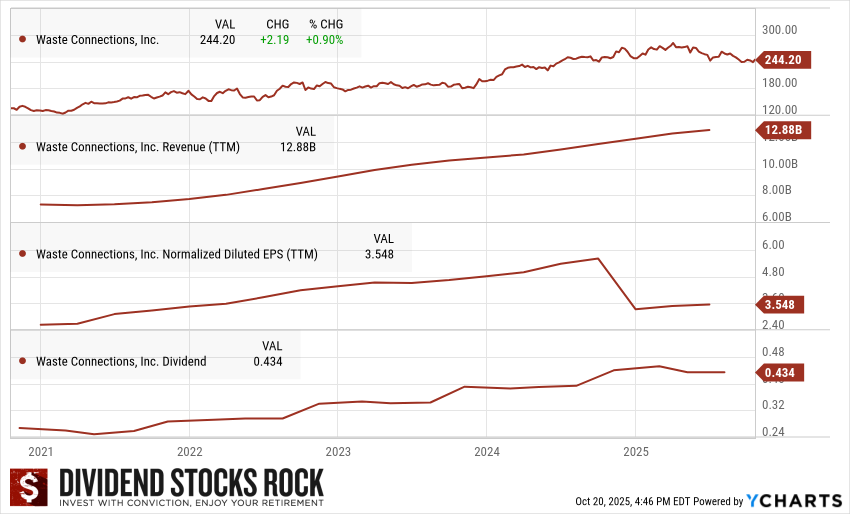
Waste Connections (WCN.TO) 5-Year Dividend Triangle chart.

Waste Connections may not boast the highest yield, but it’s a classic dividend grower. Its consistent pricing gains and cash flow discipline translate into sustainable, long-term dividend growth.

  • Revenue: $12.9 billion (TTM), rising steadily year after year.
  • Earnings per Share (EPS): $3.55 TTM, rebounding from recent acquisition-related costs.
  • Dividend: $0.434 per share, continuing its climb with a payout ratio comfortably below 25%.

The company’s dividend may look modest, but its growth record is strong, with double-digit hikes common in recent years. Investors can expect more of the same as earnings and cash flow expand.

Final Take — The Steady Hand in a Messy World

In an unpredictable market, it’s refreshing to find a company where performance isn’t tied to consumer confidence or economic cycles. Waste Connections turns necessity into opportunity, combining a recession-resistant business with disciplined management and reliable dividend growth.

Its focus on smaller markets, strong pricing power, and steady free cash flow give it a long runway for shareholder returns. This isn’t a flashy story — it’s a dependable one. And sometimes, that’s exactly what a dividend growth portfolio needs.

Find Other Buy and Hold Forever Stocks: Download the Dividend Rock Stars List

This dividend stock list is updated monthly. You will receive the updated version every month by subscribing to our newsletter. You can download the list by entering your email below.

This isn’t just a list of high-yield stocks—it’s a handpicked selection of Canada’s best dividend growth stocks backed by detailed financial analysis.

Red star.

  • Monthly updates
  • Full dividend safety ratings
  • 10+ Metrics with filters

Enter your email to get the latest Canadian Dividend Rock Stars List now!

Where Canada Trades — and Dividends Grow

Every trade, listing, and market movement in Canada traces back to one place — the TMX. But beyond the flashing tickers and daily headlines, this company has built something far more enduring: a stable, cash-generating machine that fuels dividend growth year after year. For investors seeking predictability in an unpredictable market, TMX represents the steady pulse behind Canadian capitalism itself.

The Core Engine Behind Canadian Markets

TMX Group (X.TO) operates the infrastructure that keeps Canada’s markets running. It owns and manages the Toronto Stock Exchange (TSX), TSX Venture Exchange, and Montreal Exchange, while also overseeing clearing and settlement systems through CDS and CDCC. Together, these businesses handle nearly all equity and derivatives trading in Canada — an advantage few competitors can touch.

Over time, TMX has evolved well beyond the traditional exchange model. Its data and analytics divisions — including Datalinx, Trayport, and the newly acquired VettaFi — now deliver global market data and analytics to thousands of clients. More than half of TMX’s revenue comes from recurring contracts, giving it resilience that’s rare among financial infrastructure firms.

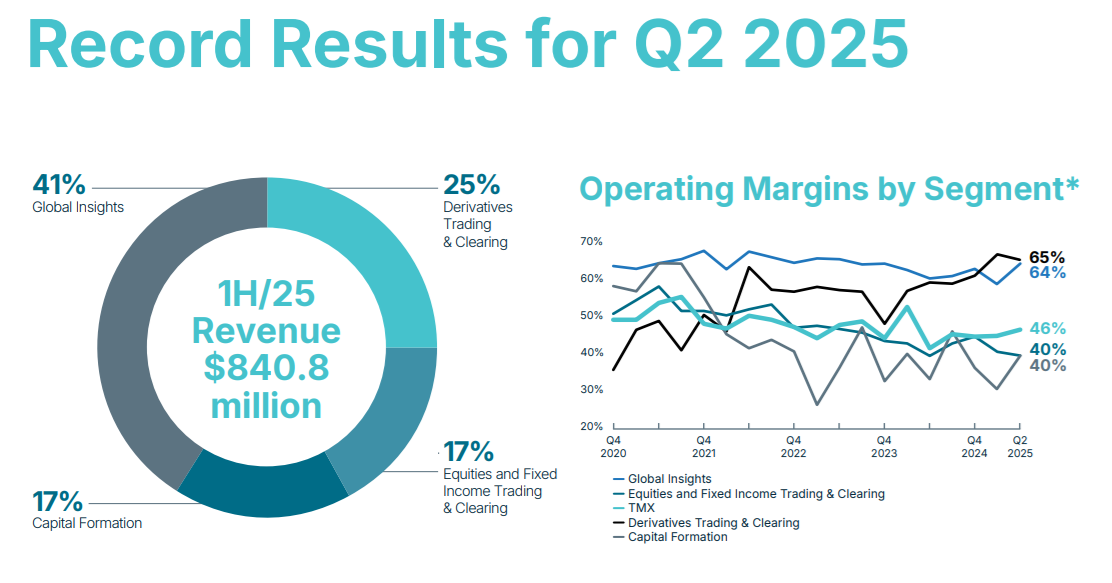
X.TO Q2 2025 results graph from its Investors Brochure.

The Investment Thesis: Stability in a Market Built on Movement

Bull Case — The Exchange That Keeps Growing

TMX has transformed itself from a cyclical exchange operator into a diversified fintech platform. Its monopoly on Canadian listings ensures a steady base of transaction and listing fees, while expanding data capabilities are driving higher-quality, recurring cash flow.

Playbook:
TMX earns revenue through trading, clearing, listings, and data. Its flagship exchanges — the TSX and MX — dominate Canadian equities and derivatives. The company’s strategy has been to expand globally through acquisitions like VettaFi and iNDEX Research, strengthening its position in the booming data and analytics space.

Growth Vectors:

  • Recurring data revenue now exceeds 50% of total sales, insulating TMX from volume swings.
  • Trayport and VettaFi have delivered double-digit growth in 2025, confirming successful integration.
  • Issuer services are rebounding as capital markets regain momentum.
  • EPS growth is projected to stay in double digits through 2026, supported by margin expansion and disciplined capital allocation.

Economic Moat:
TMX enjoys one of the strongest competitive positions in the country. Its regulatory entrenchment and control of national market infrastructure make it nearly impossible to replicate. While global exchanges compete for data and technology clients, TMX’s grip on Canadian listings and clearing systems forms a wide and stable moat for long-term investors.

Bear Case — Even Giants Can Catch the Market’s Cold

Even with diversification, TMX’s performance still depends partly on the health of equity markets. A prolonged downturn in trading or IPO activity could soften revenue growth, while operating leverage can cut into margins during weaker cycles.

Business Vulnerabilities:
TMX’s core exposure to market volumes and capital formation leaves it sensitive to investor sentiment. While recurring revenue helps, transaction-driven income remains significant — and difficult to replace if listings dry up.

Industry & Market Threats:

  • Capital migration risk to U.S. exchanges if domestic listings falter.
  • Rising competition from alternative trading systems (NEO, Nasdaq Canada, CSE) could erode share at the margins.
  • Continuous reinvestment in technology is mandatory to keep pace with global giants like ICE and Nasdaq.

Competitive Landscape:
TMX’s leadership in Canada is secure, but it faces indirect competition from international exchanges expanding into fintech and data analytics. Continued success depends on disciplined integration of new acquisitions and sustained innovation in data solutions.

Unlock More Dividend Growth Picks

Red star.If you want more hand-picked dividend growers across industries, grab our Dividend Rock Star List.

It features around 300 stocks with complete Dividend Safety Scores, growth projections, and buy lists tailored for retirement portfolios.

Most importantly, it is the ONLY list using the Dividend Triangle as its foundation.

Latest News — Data Drives Another Strong Quarter

TMX Group reported a solid quarter with revenue up 15% and adjusted EPS up 21%. GAAP EPS was down 28%, reflecting a $0.14 loss per share related to foreign exchange impacts in Q2.

Organic revenue, excluding recent acquisitions such as Newsfile, iNDEX Research, Bond Indices, and ETF Stream, grew 13%, fueled by strong performance across:

  • Derivatives trading and clearing: +33%
  • TMX Trayport: +26%
  • Equities & fixed income trading: +18%
  • TMX VettaFi: +17%

This reinforces TMX’s strategy of broadening its data ecosystem and maintaining diversified growth across core and adjacent businesses.

The Dividend Triangle in Motion

TMX Group (X.TO) 5-Year Dividend Triangle chart.

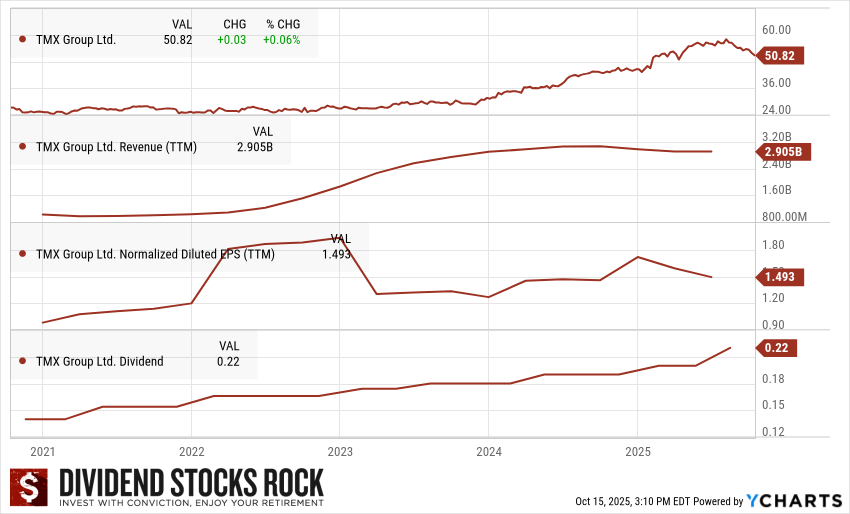
TMX’s Dividend Triangle reflects a company quietly compounding shareholder value — with consistent growth in revenue, earnings, and dividends.

  • Revenue: $2.9 billion and growing, thanks to steady trading and expanding data operations.
  • Earnings per Share (EPS): $1.49 TTM, backed by recurring income and disciplined cost management.
  • Dividend: $0.22 per share, with a solid history of increases supported by healthy free cash flow.

Final Thoughts — Owning the Exchange Pays Off

TMX isn’t the kind of stock that will double overnight, but that’s exactly what makes it attractive to dividend growth investors. Its dominance in the Canadian market infrastructure, growing data monetization engine, and consistent free cash flow generation make it a rare blend of stability and modern innovation.

For those seeking long-term compounding, TMX offers something uniquely Canadian — a steady dividend backed by the country’s financial foundation.

Want to Discover More Canadian Dividend Stars?

Join thousands of investors who rely on our Dividend Rock Star List to find dependable dividend growers across Canada and the U.S.Red star.

👉 Download your free Dividend Rock Star List today

Copyright © 2026 · Moose Markets