• Skip to main content

MOOSE MARKETS

INVESTING THE CANADIAN WAY

  • Dividend Investing
    • Best Canadian Stocks to Buy in 2025
    • Dogs of the TSX – Beat The TSX! 2025
    • Canoe Income Fund
    • Canadian Banks Ranking 2025
    • Canadian Dividend Rock Stars List
    • Canadian Dividend Aristocrats 2025
    • Buy and Hold Forever Stocks
  • REITs
    • Canadian REITs Beginner’s Guide
    • Best Monthly REITs 2025
  • How To
    • Income Products at Retirement
    • 4 Budgets of Retirement
    • Create a Cash Wedge at Retirement
    • 5 Questions for a Confident Retirement
  • ETFs
    • Guide to ETF Investing
  • Portfolio Strategies
    • Canadian Depositary Receipts (CDRs)
    • Building an Income Portfolio – Made Easy
  • Newsletter
  • Podcast

best canadian stocks 2025

Leaning on a Retail Giant for Steady Dividends

When a company builds its fortunes around one powerful partner, it can either look like a risk or a source of stability. For dividend investors, the key question is whether that dependence translates into predictable, but also growing, dividends. In the case of CT REIT, its close relationship with Canadian Tire provides both an anchor and a growth engine. While it may not offer explosive expansion, it delivers the kind of steady, reliable income stream many dividend investors value.

Anchored in Retail Real Estate

CT Real Estate Investment Trust (CRT.UN.TO) is a Canadian REIT that owns, manages, and develops commercial properties across the country. Its portfolio includes more than 375 properties totaling over 31 million square feet of gross leasable area (GLA), primarily single-tenant net lease retail properties.

The trust’s defining feature is its close relationship with Canadian Tire Corporation (CTC), which accounts for about 92% of GLA. These properties are mission-critical for CTC’s retail network, ensuring a highly stable occupancy base. CT REIT generates income through long-term triple-net leases, where tenants pay property taxes, insurance, and maintenance, providing the REIT with predictable and durable cash flows.

Management supplements this core business with property intensification projects, acquisitions, and occasional multi-tenant developments to diversify revenue.
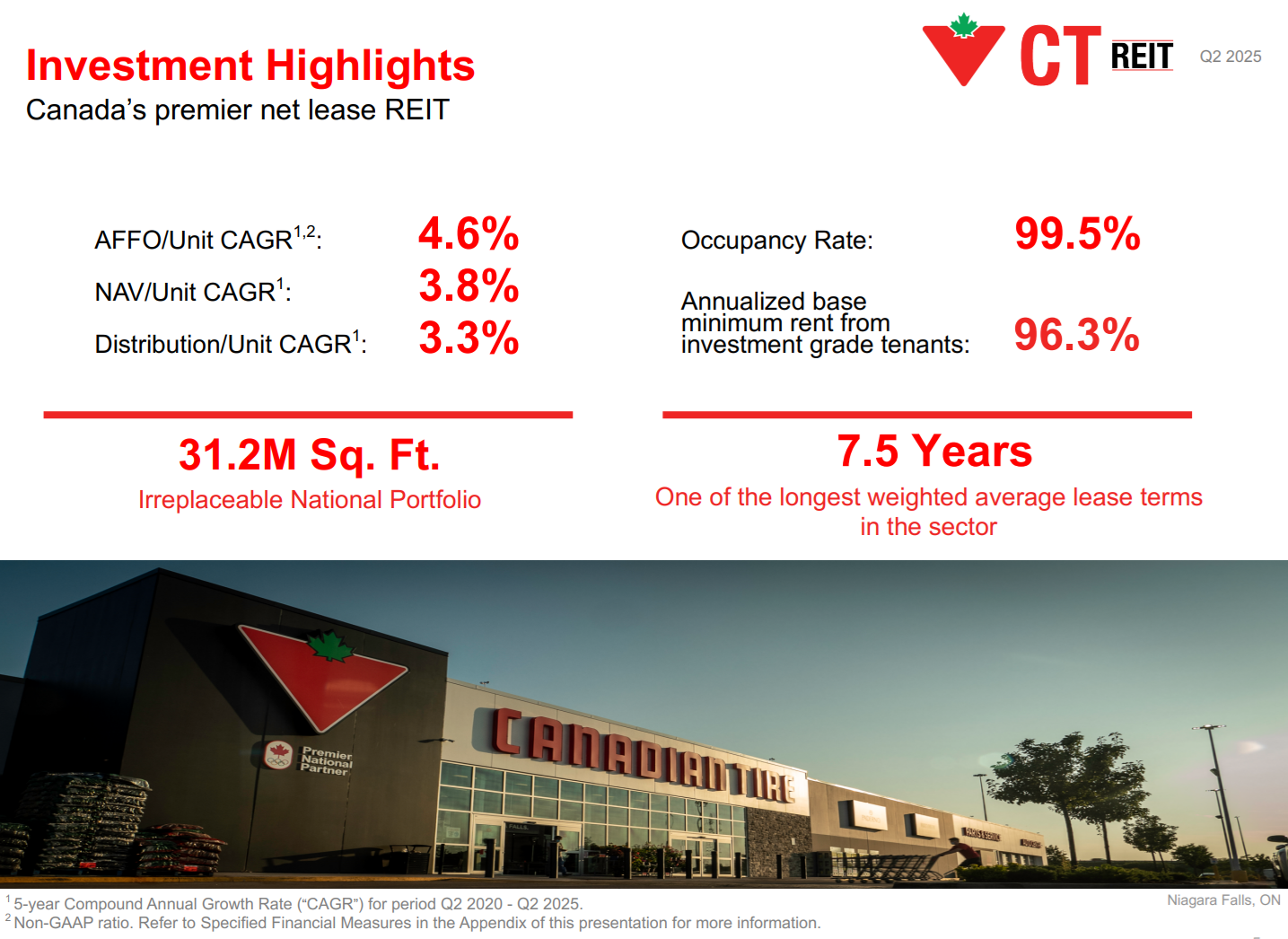
CT REIT Investment Highlights from its Q2 2025.
CT REIT Investment Highlights from its Q2 2025 presentation.

When Dependence Feels (Mostly) Like Strength

Bull Case – Why Investors Like It

  • Predictable Income Stream: With Canadian Tire as its anchor tenant, CT REIT enjoys exceptionally stable occupancy and renewal rates. Weighted average lease terms are 7.9 years, providing strong visibility on future cash flow.

  • Sustainable Dividends: The REIT pays a 6.3% yield, backed by a conservative ~72% AFFO payout ratio, leaving room for future increases.

  • Growth Levers:

    • Acquisitions of Canadian Tire properties (2 stores added in Q4 2024).

    • Intensification projects in Quebec, Saskatchewan, and a development pipeline in Kelowna, BC.

    • Lease renewals with strong pricing power (+10.3% third-party rent increase in Q4 2024).

  • Solid Balance Sheet: Management has kept debt levels manageable, supporting both dividend stability and growth initiatives.

Bear Case – Risks You Can’t Ignore

  • Tenant Concentration: With over 90% of space leased to Canadian Tire, CT REIT’s fortunes are tightly linked to a single retailer. If Canadian Tire faces operational or strategic challenges, the REIT’s revenue would feel it immediately.

  • Limited Diversification: Unlike larger diversified REITs (e.g., retail + industrial + residential), CT REIT remains focused on one category, leaving little cushion if retail traffic declines.

  • Slow Growth Profile: NOI growth is modest (1.5%–2.0% annually). Investors looking for high growth will find this REIT more of a “bond proxy” than a growth story.

Free Webinar Invite: Avoid Price Confusion and Act with Conviction

When a stock dives or spikes, most investors focus on the price. That’s the wrong move. In this live session, I’ll show you how to ignore the noise and interrogate the business—so you can decide with confidence whether to sell, hold, or buy more.

New Webinar Invite
New Webinar Invite

Thursday, September 18th at 1:00 p.m. ET
~50 minutes + 1-hour Q&A
Replay available for all registrants
Seats are limited to the first 500

You’ll discover:

  • A simple framework to know when to ignore headlines and when to act

  • A quick business-model check that surfaces real risks (fast)

  • How to use the Dividend Triangle to separate bargains from traps

Save your spot (or get the replay)

What’s New: Expansion Keeps the Wheels Turning

CT REIT’s latest quarter showed steady progress:

  • Revenue: +4% YoY.

  • FFO per unit: +2%.

  • NOI: $118.9M (+3.4% YoY).

  • Payout Ratio: 72% (comfortably sustainable).

  • Key drivers:

    • Completed property acquisitions and intensifications in 2024–2025 (+$3.1M).

    • Rent escalations from Canadian Tire leases (+$1.7M).

The Dividend Triangle in Action: Slow & Steady Growth
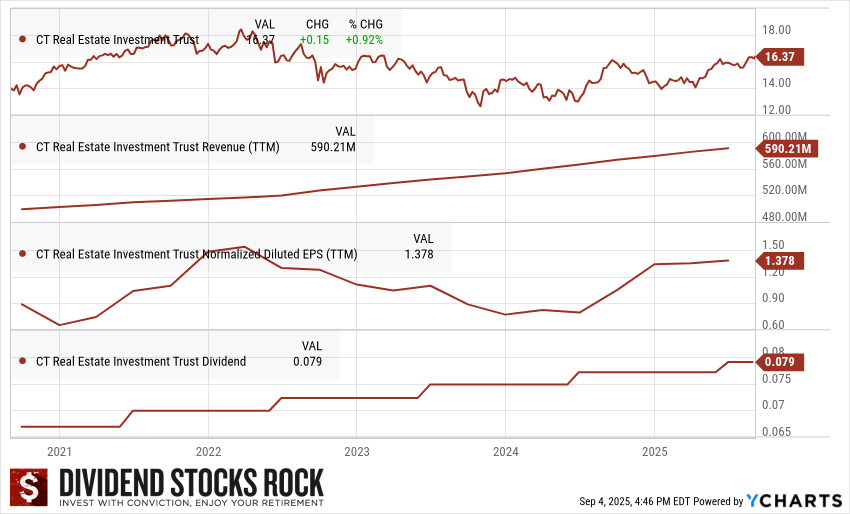
CT REIT (CRT.UN.TO) 5-year Dividend Triangle chart.

When we look at CT REIT through the lens of the Dividend Triangle, the picture is clear: this is a story of income stability rather than rapid growth.

  • Revenue: Gradually rising, supported by acquisitions and annual lease escalations.

  • EPS/FFO: Consistent, with minor fluctuations tied to timing of developments.

  • Dividend: Modest but reliable, growing in step with AFFO and maintaining a sustainable payout ratio.

CT REIT isn’t here to deliver explosive growth. Instead, it delivers the kind of slow, predictable compounding that income-focused investors prize.

Final Thoughts: Built to Last, Not for Excitement

CT REIT is less about chasing growth and more about locking in dependable monthly income. With Canadian Tire as its anchor and a disciplined payout strategy, the trust is positioned as a steady, income-first REIT. The trade-off? Limited diversification and modest long-term growth.

For dividend investors who prioritize stability and cash flow visibility, CT REIT remains a compelling option.

Free Webinar: Avoid Price Confusion

Stocks often jump or drop 10% on earnings day. How do you know if it’s time to buy, sell, or simply hold?

Join me on Thursday, September 18th, at 1:00 p.m. ET for a free session where I’ll share how to cut through the noise, check the business fast, and use the Dividend Triangle to spot real opportunities.
Save your seat (or get the replay)

A Steady Pace Toward Dividend Growth

Dividend investing is not about sprinting ahead—it’s more about maintaining a steady pace that delivers reliable results over time. Think of it like a marathon runner: disciplined, consistent, and built to withstand the test of endurance. Some businesses mirror that approach perfectly, combining stable cash flows with long-term strategies that enable dividends to continue growing. For investors seeking both income and peace of mind, this kind of stability can be just as rewarding as high-growth stories.

A Business Anchored in Protection and Wealth

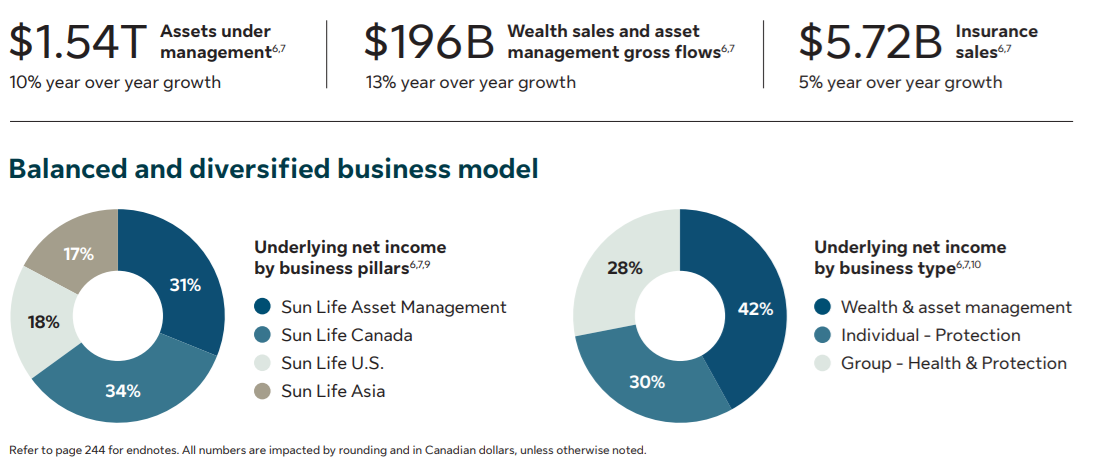
Sun Life (SLF.TO) operates across five key segments: Asset Management, Canada, U.S., Asia, and Corporate. Its business mix reflects three pillars:

  • Asset management & wealth – through MFS and SLC Management, which collectively oversee more than CAD 1 trillion in assets under management.

  • Group health & protection – providing benefits like dental, life, and disability insurance to employers and government programs.

  • Individual protection – traditional life and health insurance offerings sold directly to consumers.

In Canada, Sun Life dominates group insurance and retirement solutions. In the U.S., its acquisition of DentaQuest made it the #2 dental benefits provider. In Asia, it has tapped into high-growth markets where protection and wealth products are in demand. Together, these businesses create a diversified but competitive platform.

Sun Life Financial (SLF.TO) Financial Highlights and Business Model from its 2024 Annual Report.

Building Growth Beyond Insurance

The Bull Case

Sun Life is not just an insurance company anymore—it’s an asset manager, a group benefits leader, and an international operator. Roughly 42% of its earnings now come from asset and wealth management, offering stable, fee-based cash flows that buffer against insurance volatility.

  • Asset Management Powerhouse – MFS and SLC Management continue to scale. SLC has been expanding into alternatives, which command higher fees and offer growth potential even in volatile markets.

  • Group Benefits Leadership – In Canada, Sun Life’s group insurance footprint is unmatched, supporting recurring revenues tied to employer coverage. In the U.S., its DentaQuest acquisition broadened its reach, adding long-term growth potential.

  • Asian Expansion – Sun Life has reported record net income from Asia, where demand for protection products and wealth solutions remains high. This region is an essential long-term growth vector.

  • Tailwinds from Rates – Rising interest rates improve yields on Sun Life’s large fixed-income portfolio, directly benefiting investment income.

Demographics are also working in Sun Life’s favor. An aging population in North America is fueling demand for retirement planning and protection products, while middle-class growth in Asia supports wealth and insurance demand.

The Bear Case

Despite its diversification, Sun Life faces familiar industry headwinds. Insurance remains a commoditized business, where pricing—not brand—is the main competitive factor. Asset management, while profitable, is vulnerable to market downturns and investor outflows.

  • Interest Rate Sensitivity – Rising rates provide a short-term boost, but prolonged low-rate environments in the past have shown how thin insurance margins can get.

  • Market Exposure – With over CAD 1 trillion AUM, market corrections would directly hit Sun Life’s fee income. MFS already reported challenges from lower average assets.

  • Competitive Pressures – In insurance, Manulife and Great-West Life are fierce rivals in Canada, while global giants dominate in the U.S. and Asia. In asset management, Sun Life is a fraction of the size of BlackRock or Vanguard, making pricing pressure a constant risk.

  • Political and Regulatory Risks – Like all insurers, Sun Life must navigate evolving regulations, particularly in health and retirement products. Any policy shifts could alter profitability in key regions.

While the company has shifted away from struggling U.S. life insurance operations, it still depends on execution in newer markets to keep growth alive.

Free Webinar Invite: Avoid Price Confusion and Act with Conviction

When a stock dives or spikes, most investors focus on the price. That’s the wrong move. In this live session, I’ll show you how to ignore the noise and interrogate the business—so you can decide with confidence whether to sell, hold, or buy more.

New Webinar Invite
New Webinar Invite

Thursday, September 18th at 1:00 p.m. ET
~50 minutes + 1-hour Q&A
Replay available for all registrants
Seats are limited to the first 500

You’ll discover:

  • A simple framework to know when to ignore headlines and when to act

  • A quick business-model check that surfaces real risks (fast)

  • How to use the Dividend Triangle to separate bargains from traps

Save your spot (or get the replay)

What’s New: Record Earnings from Asia and Mixed Trends Elsewhere

Sun Life’s latest quarter (August 20, 2025) showcased both strengths and challenges:

  • Core EPS up 13.5% year-over-year.

  • Asset Management & Wealth delivered $455M in net income (flat).

  • Group Health & Protection rose 7% to $326M.

  • Individual Protection surged 110% to $299M, rebounding from softer prior-year results.

  • Asia posted record earnings on strong protection growth and higher wealth contributions.

  • U.S. Dental saw gains from Medicaid repricing.

  • Canada benefited from favorable group life mortality but softer individual protection.

Overall, the quarter confirmed Sun Life’s ability to grow earnings across multiple levers, but also highlighted its exposure to market-linked asset management results.

The Dividend Triangle in Action: Measured but Steady

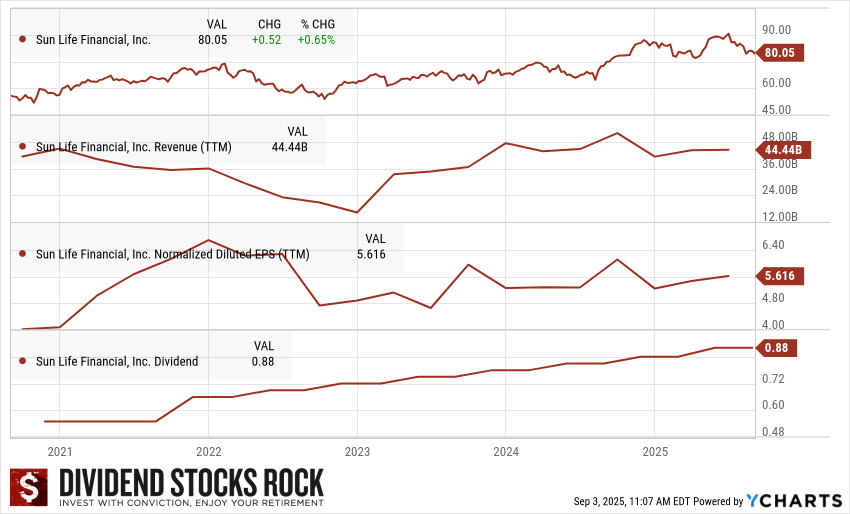
Sun Life Financial (SLF.TO) 5-year Dividend Triangle chart.

The dividend story at Sun Life is one of consistency rather than excitement. Revenue and EPS have climbed steadily, though not spectacularly, while the dividend has marched upward in tandem.

  • Revenue: Stable, with gradual growth supported by asset management and group benefits.

  • Earnings per Share (EPS): Lumpy due to market-linked businesses, but the long-term trend remains positive.

  • Dividend: A modest yield, but with dependable growth—management increased the dividend by 6% in 2025.

This is not a high-yield stock, but rather a dividend grower that can serve as part of a balanced portfolio.

Final Thoughts: Dividend Growth that Endures

Some businesses are built for endurance rather than speed. This one has proven it can steadily grow earnings, manage through cycles, and reward shareholders along the way. With its mix of insurance, wealth, and asset management, it may not consistently deliver fireworks. Still, it offers something even more valuable for dividend investors: the confidence that your income can continue to grow year after year.

Free Webinar: Avoid Price Confusion

Stocks often jump or drop 10% on earnings day. How do you know if it’s time to buy, sell, or simply hold?

Join me on Thursday, September 18th, at 1:00 p.m. ET for a free session where I’ll share how to cut through the noise, check the business fast, and use the Dividend Triangle to spot real opportunities.
Save your seat (or get the replay)

Engineering Growth in a Changing World

Infrastructure, sustainability, and urban development are long-term investment themes that require specialized expertise. One Canadian company has positioned itself at the center of these trends, delivering engineering, architecture, and consulting services that help governments and corporations adapt to climate change, modernize infrastructure, and manage resources responsibly. With a diversified portfolio and strong project backlog, this business is well-placed to capture steady growth in the coming years.

Building the Foundations of Tomorrow

Stantec (STN.TO) is a global engineering and design firm that provides sustainable solutions across multiple industries. Its business model spans five major operating units: Infrastructure, Water, Buildings, Environmental Services, and Energy & Resources. This diversified structure enables Stantec to balance revenue between government contracts, private sector projects, and recurring environmental consulting.

The company operates in three geographic segments—Canada, the U.S., and Global markets. Its top 25 clients are highly engaged, with more than half using services from at least four of its business units. This multi-service approach creates strong client retention and cross-selling opportunities. Stantec covers the full project life cycle: from concept and planning to design, construction management, and even remediation and decommissioning.

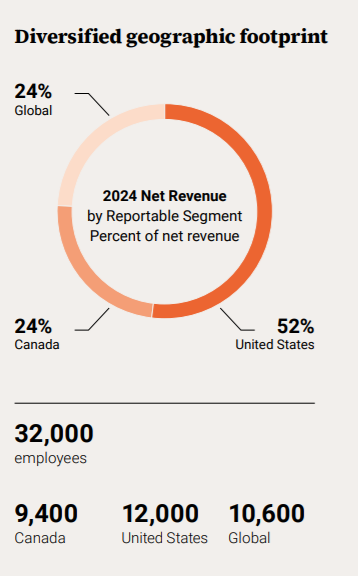
Stantec (STN.TO) Diversified Geographic Footprint form their 2024 Annual Report.
Stantec (STN.TO) Diversified Geographic Footprint from its 2024 Annual Report.

The Bull Case: Riding the Infrastructure Wave

Stantec is in an enviable position as one of the world’s leading engineering and consulting firms, with exposure to some of the strongest long-term demand drivers in the industry.

Playbook
The company focuses on government infrastructure contracts and private sector capital projects. Its business mix reduces volatility compared to firms that rely heavily on cyclical sectors like mining or oil and gas. With a $7.9B backlog—equivalent to roughly 13 months of work—Stantec enjoys strong revenue visibility.

Growth Vectors

  • Government Infrastructure Spending: In both the U.S. and Canada, government programs are allocating billions toward modernizing transportation, energy grids, and water systems.

  • Water Segment Strength: Backlog in Water grew 24% YoY, reflecting rising demand for clean water and wastewater management solutions.

  • Strategic Acquisitions: Stantec continues to use M&A to broaden expertise and geographic reach. With an under-leveraged balance sheet, it has flexibility for future deals.

  • Energy Transition Projects: Increasing demand for renewable energy and carbon reduction strategies has created new growth avenues.

  • Geographic Diversification: With about half its revenue from the U.S., one-quarter from Canada, and the rest international, Stantec is not overly reliant on any single region.

Economic Moat
Stantec’s moat lies in its diversified expertise, strong client retention, and international presence. Its ability to provide integrated solutions across sectors makes it a trusted long-term partner. While margins are pressured by competition, its backlog and breadth of services offer resilience compared to smaller peers.

Want More Stocks Like This One?

The Dividend Rock Star List is our hand-picked collection of quality dividend stocks.
Here’s what you’ll find inside:

  • 🔍 Over 300 U.S. and Canadian dividend-paying stocksRed star.

  • ✅ Screened using our Dividend Triangle: Revenue growth, EPS growth, and dividend growth

  • 🚨 Updated monthly with the latest data

  • 📊 Filter by yield, sector, payout ratio, dividend growth rate, and more

  • 💡 Discover reliable growers that can power your portfolio through bull and bear markets

Start browsing the Dividend Rock Star List now and find your next winner before everyone else does.

The Bear Case: Cycles, Talent, and Competition

Despite its strengths, Stantec faces risks tied to its cyclical industry, dependence on skilled labor, and a competitive marketplace.

Business Vulnerabilities
Stantec relies on government budgets and private sector investments. In an economic downturn, project approvals could be delayed, reducing growth. Its historical performance between 2017 and 2022 was uneven, reflecting how cycles affect consulting firms.

Industry & Market Threats

  • Talent Shortages: Engineering and environmental consulting are labor-intensive. Wage inflation and retention challenges could erode margins.

  • Acquisition Risks: While acquisitions are a growth driver, overpaying or poor integration could dilute shareholder value.

  • Cyclical Nature: Stantec’s revenue growth is closely tied to macroeconomic trends in infrastructure and construction.

Competitive Landscape
Stantec competes with global heavyweights such as WSP Global and Tetra Tech, along with numerous regional firms. WSP, with roughly double the market cap and revenue, benefits from greater scale and financial flexibility. This puts pressure on Stantec to remain competitive on both pricing and acquisitions.

What’s New: Strong Quarter Highlights Water

On August 19, 2025, Stantec delivered a solid quarter:

  • Revenue up 7% YoY, including 4.8% organic growth.

  • EPS up 21%, supported by higher project margins and lower administrative expenses.

  • Regional Growth: U.S. +5.7%, Canada +6.2%, Global +10.5%.

  • Water Segment Strength: Continued double-digit organic growth, confirming robust demand.

The results reinforce management’s optimism, as Stantec raised its 2025 and 2026 earnings estimates.

The Dividend Triangle in Action: Steady Climb

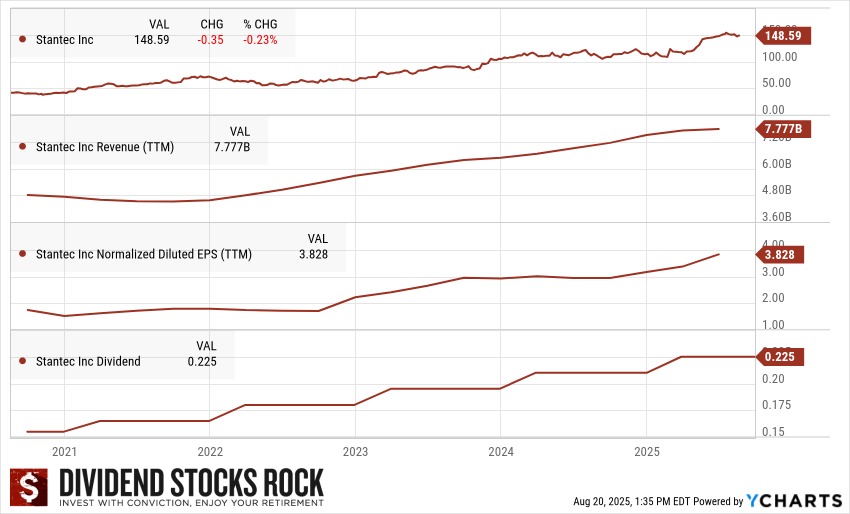
Stantec (STN.TO) 5-year Dividend Triangle chart.

Looking at the Dividend Triangle:

  • Revenue has grown steadily, reaching $7.8B.

  • EPS has accelerated, now at $3.83.

  • Dividend growth, while modest, has been consistent, with the payout now at $0.225 per share.

Stantec’s dividend yield remains on the low side, but its strength lies in sustained growth potential and strong earnings momentum to support future increases.

Build a Smarter, Safer Dividend Portfolio

Whether you’re looking for income today or wealth tomorrow, you need stocks that deliver on all three parts of the Dividend Triangle.

That’s exactly what the Dividend Rock Star List is built for:

  • No fluff — just fundamentally strong dividend stocks

  • Red star.

    Includes both Canadian and U.S. dividend payers

  • Easily sort by dividend growth rate, payout ratio, and more

  • Updated every month — no stale picks, no guesswork

Use it to build your watchlist, strengthen your portfolio, or start fresh with confidence.

Explore the Dividend Rock Star List now:

Final Thoughts: A Reliable Builder in Any Market

Stantec’s diversified service portfolio, strong backlog, and alignment with secular trends like climate adaptation, clean water, and infrastructure modernization make it a compelling pick in the engineering and consulting space. While competition and talent risks are worth monitoring, its growth trajectory appears well supported. For long-term investors, Stantec represents a steady growth-and-income story in a critical industry.

Best Canadian Stocks to Buy in 2025

Most of the best Canadian stocks pay a dividend. Known for their stability when markets are rough, they also provide income to investors quarterly. Companies in sectors such as utilities, REITs, and banks can protect you against market fluctuations and severe losses.

Yet, not all dividend-paying companies are good investments. Investing in dividend stocks can lead to painful losses and income cuts. The risk of falling for dividend traps or seeing your retirement income plummet due to the wrong stock selection is too frequent.

The market creates bubbles and hurts your portfolio. You worked hard to invest money, and you shouldn’t lose it to the wolves of Bay Street. There is a way you can invest safely in Canadian dividend stocks. We have selected some high-quality stocks to make your life easier.

Best Canadian Dividend Stocks for 2025

When I built my retirement portfolio, I focused on companies showing a combination of safe income and steady growth. My choices include Canadian Dividend Aristocrats (companies showing several years of consecutive dividend increases). I added a few more metrics and used the DSR stock screener to refine my research.

Here are some of the best Canadian Dividend Stocks for 2025:

#10 Telus (T.TO)

#9 Granite REIT (GRT.UN.TO)

#8 Hydro One (H.TO)

#7 Dollarama (DOL.TO)

#6 Canadian Natural Resources (CNQ.TO)

#5 CCL Industries (CCL.B.TO)

#4 Brookfield Corp (BN.TO)

#3 Brookfield Renewables (BEPC.TO)

#2 National Bank (NA.TO)

#1 Alimentation Couche-Tard (ATD.TO)

More Stock Ideas and Sectors’ Insights

Unlock More Dividend Growth Picks

Red star.If you want more hand-picked dividend growers across industries, grab our Dividend Rock Star List.

It features around 300 stocks with complete Dividend Safety Scores, growth projections, and buy lists tailored for retirement portfolios.

Most importantly, it is the ONLY list using the Dividend Triangle as its foundation.

#10 Telus (T.TO)

About a year ago, Telus was upgraded to a PRO rating of 5. I thought the company would bounce back faster, but it wasn’t the case. My long-term view of Telus hasn’t changed, though.

While the company reported modest revenue growth throughout the year, its cash flow metrics (cash flow from operations, free cash flow and capital expenditure) have improved significantly. The company is covering their dividend from free cash flow and interest charges are under control.

It took longer than expected, but I believe Telus will get out of this rut and make investors happy. It’s only a matter of time.

#9 Granite REIT (GRT.UN.TO)

Granite is a very frustrating REIT to hold. I love the investment thesis which includes the strong need for industrial properties, GRT’s ability to grow its business while growing FFO per unit and distribution increases intact and the high occupancy rate. The financial metrics back this investment thesis as revenue, Funds from operations, FFO per units, payout ratio and occupancy rate are all looking good. Why is GRT frustrating to hold? Because it simply doesn’t get any love from the market. Despite its good numbers, GRT lags the market and fails to generate positive returns.

With a low FFO payout ratio (68% for the first 9 months of 2024), shareholders can enjoy a 4.5% yield that should grow and match (or beat) the inflation rate. This is among the rare REITs exhibiting AFFO per unit growth while issuing more units to finance growth.

#8 Hydro One (H.TO)

From time to time, I hear that Hydro-Quebec should go public and unlock tons of value. However, I understand the government’s provincial point of view of keeping this amazing asset for themselves. Do you know why? Because Hydro-Quebec pays a generous dividend to the government each year!

Well, Hydro One is in a similar situation but you have the possibility of getting a piece of the cake as the Ontario Government decided to sell a part of its stake in this beauty. With 99% of its operations being regulated and 98% of its electric lines being in Ontario, an investment in Hydro One is a pure play on Ontario’s power development. This is the pure definition of a sleep-well-at-night investment. The company expects to invest $1.3B to $1.6B in CAPEX yearly until 2027 which will support their EPS growth guidance of 4-7% and dividend growth of about 5%. The province enjoys a strong and diversified economy and Hydro One will continue to grow by walking in the province’s path.

#7 Dollarama (DOL.TO)

Dollarama storefront sign

I’m kicking myself for not having Dollarama in my portfolio. Maybe in another life!

DOL has built a strong brand, and its business model (aimed at low-value items) is an excellent defensive play against the e-commerce threat over the retail business. As consumers’ budgets are tight, DOL appears to be an amazing alternative for many goods. Dollarama has been able to increase same store sales along with opening new stores consistently. The introduction of many products under its “home brand” increases the company’s margin. DOL introduced a new price point of $5 for many items, which lends additional flexibility and pricing power.

#6 Canadian Natural Resources (CNQ.TO)

CNQ is a rare beast in its environment that has increased dividends for 25 consecutive years. Yes, it even increased its payouts while everybody was on hold or cutting distributions in 2020. It brings the question: why is CNQ “oil price resistant”?

The company is sitting on a large reserve of cheap oil. According to management, CNQ is profitable with an oil price per barrel of around $35-$40. This enables the company to manage production and capex with greater flexibility. They can then slowdown CAPEX when the oil price is low and produce less. When we are in “full oil bull mode”, CNQ bolsters CAPEX and boosts production generating maximum cash flow. This is exactly what just happened where CNQ dropped its debt and now focuses on rewarding shareholders with share buybacks and dividend increases.

To be clear, I don’t see CNQ as a super powered growth stock for the future. However, with a yield above 4% and a resilient business model, that’s the type of business that will either be very good in your portfolio, or it will go back into hibernation mode paying a secure dividend. In both scenarios, you can be a winner over the long run.

#5 CCL Industries (CCL.B.TO)

Finding an international leader with a well-diversified business based in Canada is rare. Through the major acquisition of business units from Avery (world’s largest supplier of labels) in 2013, the company has set the tone for several years of growth. Bolstered by its previous successes, CCL also bought Checkpoint, a leading developer of RF and RFID, and Innovia in the past few years and announced more acquisitions in 2021. The company is still able to generate organic growth (roughly 4-5%) on top of its growth through acquisitions.

#4 Brookfield Corporation (BN.TO)

I’m keeping BN among my top picks for a third year in a row. The 2024 selection paid off as Brookfield skyrocketed with more than 50% return. I think there is much more to come! Brookfield is amongst the largest players in alternative asset management. As the stock market looks overvalued, many investors will turn toward alternative assets as a way to generate profits and hedge their bets. Those long-term assets require patient capital and a high level of expertise. Brookfield is in a perfect position to provide this service to investors. Even better, BN invests its own capital in many projects. Therefore, it can double-dip by charging a fee on managed capital and making capital gains when selling assets.

#3 Brookfield Renewables (BEPC.TO)

BEP enjoys large-scale capital resources and has the expertise to manage its projects across the world. Management aims for a 5-9% annual distribution increase, backed by double-digit guidance that includes a mix of organic and M&A growth. Investors gravitate toward clean energy, and BEP is well-positioned to attract them.

Following an impressive stock price surge through 2020, the stock has been trending down for the past two years, although there is nothing to worry about. The rise of interest rates on bonds combined with the incredible ride BEP has had is responsible for this correction. In late 2023, management reaffirmed its strong position and ability to generate strong returns over the long haul. The latest results in early 2024 confirmed that BEP is still focused on growth opportunities. In Q2 of 2024, management highlighted the important contract signed with Microsoft to supply 10.5GW to support MSFT’s AI and cloud business energy needs. This could open the doors to more deals with corporations in the future.

#2 National Bank (NA.TO)

National Bank logo

There is no secret here as I’m a National Bank fan. It seems that the bank has done everything right over the past 15 years. This big transformation converted a small provincial bank into a serious player in capital markets and the private wealth industries. The Bank is expected to complete a key acquisition of Canadian Western Bank in 2025 which will bring more capital onto its balance sheet (supporting capital market lucrative operations), more synergies (high cross-selling opportunities between CWB’s commercial clients and private wealth management) and a good presence in Western Canada. NA is also doing very well in Cambodia (Aba Bank) and through its door into the U.S. (Credigy).

#1 Alimentation Couche-Tard (ATD.TO)

I might never have another choice for Canadian than Couche-Tard. I’ve looked at grocery stores, but Metro (MRU.TO) and Loblaws (L.TO) don’t offer many growth opportunities. Don’t get me wrong, they are great companies, but I think ATD will do better.

Things are changing quickly around the 7-Eleven deal. ATD has tried to get to the negotiation table to acquire 7-Eleven for a few months now. The Japanese company is trying all means to stay Japanese. The latest chatter was that the son’s founder would buy it back and make it private. The market liked the idea, and the ATD share price rose again. This story isn’t over yet one way or another.

For 2025, I see ATD striking another acquisition. After all, it’s in its DNA. If it’s not 7-Eleven, it will be another chain (maybe Casey’s?… it tried to acquire CASY in 2010). ATD must gain more expertise in growing organically through the sale of read-to-eat and fresh produce. This is how they can mitigate the impact of slowing fuel and tobacco sales over the next 10-20 years.

Unlock More Dividend Growth Picks

Red star.If you want more hand-picked dividend growers across industries, grab our Dividend Rock Star List.

It features around 300 stocks with complete Dividend Safety Scores, growth projections, and buy lists tailored for retirement portfolios.

Most importantly, it is the ONLY list using the Dividend Triangle as its foundation.

Copyright © 2026 · Moose Markets