• Skip to main content

MOOSE MARKETS

INVESTING THE CANADIAN WAY

  • Dividend Investing
    • Best Canadian Stocks to Buy in 2025
    • Dogs of the TSX – Beat The TSX! 2025
    • Canoe Income Fund
    • Canadian Banks Ranking 2025
    • Canadian Dividend Rock Stars List
    • Canadian Dividend Aristocrats 2025
    • Buy and Hold Forever Stocks
  • REITs
    • Canadian REITs Beginner’s Guide
    • Best Monthly REITs 2025
  • How To
    • Income Products at Retirement
    • 4 Budgets of Retirement
    • Create a Cash Wedge at Retirement
    • 5 Questions for a Confident Retirement
  • ETFs
    • Guide to ETF Investing
  • Portfolio Strategies
    • Canadian Depositary Receipts (CDRs)
    • Building an Income Portfolio – Made Easy
  • Newsletter
  • Podcast

Sun Life Financial stock

The Best Canadian Dividend Insurance Companies

When markets get choppy, insurance companies often do their best work — quietly stabilizing your portfolio while the rest of the market swings from optimism to panic. These stocks may not lead rallies, but they help investors stay invested when volatility hits.

Canadian insurers bring a unique kind of strength to a dividend growth portfolio. Their business models thrive on risk management, consistent cash flows, and disciplined capital allocation. When well-managed, they deliver the trifecta every long-term investor wants: steady earnings, sustainable dividend growth, and resilience across economic cycles.

Today, we’re looking at four of the strongest Canadian insurance companies — each with its own mix of stability, growth potential, and dividend power.

4. Manulife Financial (MFC.TO)

Investment Thesis

Manulife Financial has rebuilt its reputation since the financial crisis and now stands as a well-diversified global insurance and wealth management powerhouse. With operations in Canada, the U.S., and Asia, it benefits from both mature and high-growth markets. The company’s asset management arm oversees over CAD 1 trillion in assets, generating a steady stream of fee-based income.

Its Asian segment—now roughly 30% of total earnings—is the key growth engine. Rising middle-class populations and underpenetrated insurance markets in countries like China, Japan, and Hong Kong make this region a massive opportunity. The company’s pivot toward behavioral insurance and investment management also supports long-term profitability.

Manulife may not have a strong moat in a commoditized industry, but it has evolved into a leaner, more efficient, and more globally balanced insurer than it was a decade ago.
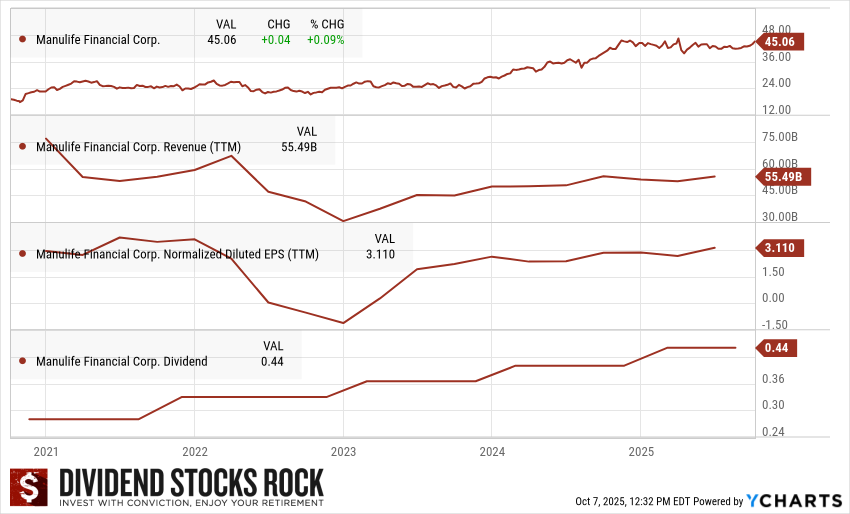
Manulife (MFC.TO) 5-year Dividend Triangle Chart.

Potential Risks

Manulife’s reliance on capital markets makes it more volatile than some of its peers. A downturn or sharp interest rate decline could compress investment income and returns. Its U.S. operations under John Hancock remain a weak link, with thin margins and fierce competition.

In Asia, while the long-term growth story remains intact, the company faces local competitors with deep roots and faster product innovation. The insurance business is price-driven, limiting differentiation and putting pressure on returns.

Unlock More Dividend Growth PicksRed star.

If you want more hand-picked dividend growers across industries, grab our Dividend Rock Star List.

It features around 300 stocks with complete Dividend Safety Scores, growth projections, and buy lists tailored for retirement portfolios.

Most importantly, it is the ONLY list using the Dividend Triangle as its foundation.

3. Great-West Lifeco (GWO.TO)

Investment Thesis

Great-West Lifeco is the definition of a steady compounder. With roots in life insurance, pension management, and asset management, it generates highly predictable cash flows. Its Empower Retirement division is now the #2 U.S. retirement services provider, expanding GWO’s reach into one of the world’s largest pension markets.

The company’s strategy emphasizes fee-based revenue and cost discipline. Recent acquisitions in the U.S. and Japan add diversification, while higher interest rates boost returns on investment portfolios. Its strong connection to Power Corporation provides both stability and a deep distribution network.

While not a fast grower, Great-West Lifeco offers stability and consistent dividend growth—an ideal fit for conservative dividend investors.
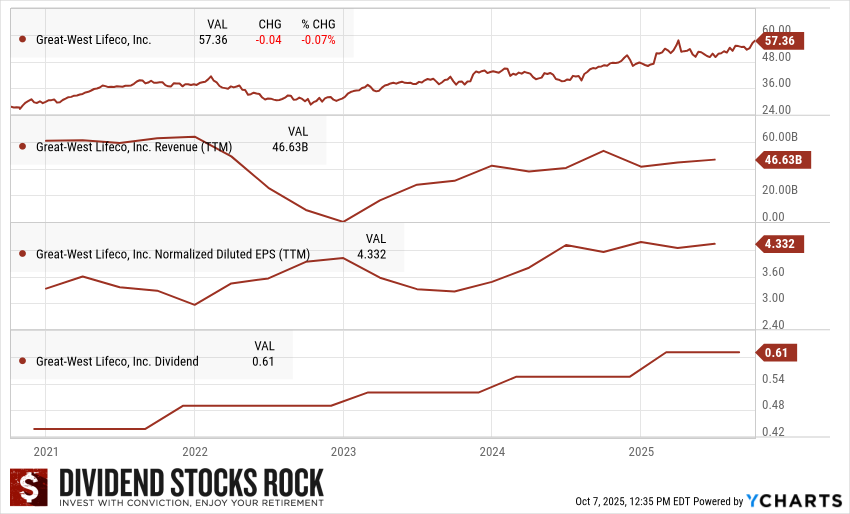
Great-West Lifeco (GWO.TO) 5-year Dividend Triangle Chart.

Potential Risks

The flip side of GWO’s stability is limited growth potential. With only 20% of revenue outside North America and Europe, it lacks exposure to high-growth emerging markets. Fee compression in asset management and regulatory capital requirements could also weigh on margins.

Insurance products are largely commoditized, and GWO competes in mature markets with intense pricing pressure. While its cost structure is efficient, sustaining above-average ROE will require continued discipline and favorable market conditions.

2. Sun Life Financial (SLF.TO)

Investment Thesis

Sun Life combines traditional insurance with a powerful asset management and group benefits platform. With over CAD 1 trillion in assets under management, it earns nearly half its profits from wealth and asset management—a steady, fee-based source of income that cushions against insurance volatility.

Its group benefits and dental insurance operations give it scale and recurring cash flow, particularly after acquiring DentaQuest, making it the #2 dental benefits provider in the U.S. Sun Life’s strength lies in diversification: Canada provides steady profits, Asia offers long-term growth potential, and its U.S. business adds scale.

The company has positioned itself as a balanced player in an unpredictable industry, with strong capital discipline and an eye toward gradual, sustainable growth.
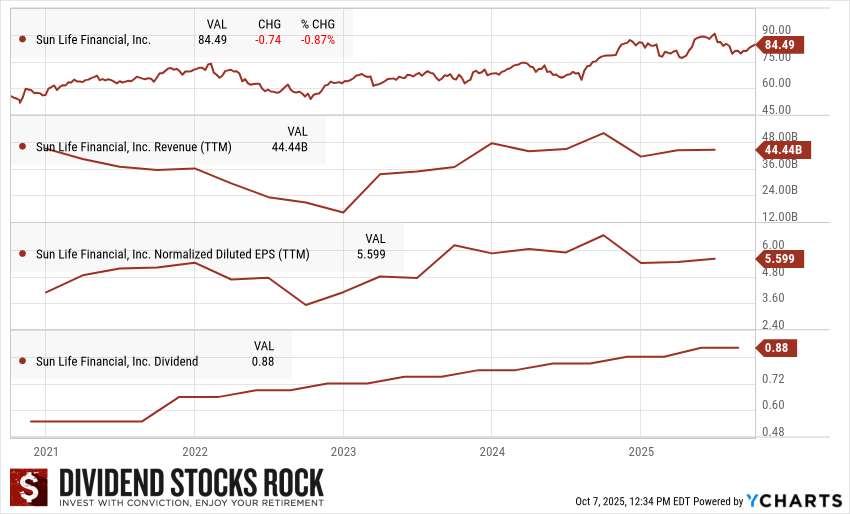
 Sun Life Financial (SLF.TO) 5-year Dividend Triangle Chart.
Sun Life Financial (SLF.TO) 5-year Dividend Triangle Chart.

Potential Risks

Sun Life’s results are highly tied to interest rate movements and financial markets. A sustained decline in rates would pressure margins and profitability. In addition, its international operations—especially in Asia—remain smaller than Manulife’s, limiting its global growth potential.

The company also operates in an increasingly commoditized industry where pricing remains a key battleground. Asset management, while profitable, faces fee compression from low-cost giants like BlackRock and Vanguard.

A Steady Pace Toward Dividend Growth

🔗 Full Sun Life Analysis

 1. Intact Financial (IFC.TO)

Investment Thesis

Intact Financial is the heavyweight of Canada’s property and casualty (P&C) insurance industry. Unlike its life insurance peers, Intact’s strength lies in underwriting excellence and data-driven pricing. Through acquisitions like RSA Insurance (U.K./Canada) and OneBeacon (U.S.), Intact has become a diversified, international P&C leader.

It continues to grow organically, targeting 10%+ annual growth in net operating income per share (NOIPS). The company’s multichannel approach—through BrokerLink, Belairdirect, and commercial lines—spreads risk and enhances resilience.

Intact’s profitability metrics remain best-in-class, supported by AI-based risk modeling and cost efficiency. Even as catastrophic losses rise, its underwriting discipline ensures steady returns.
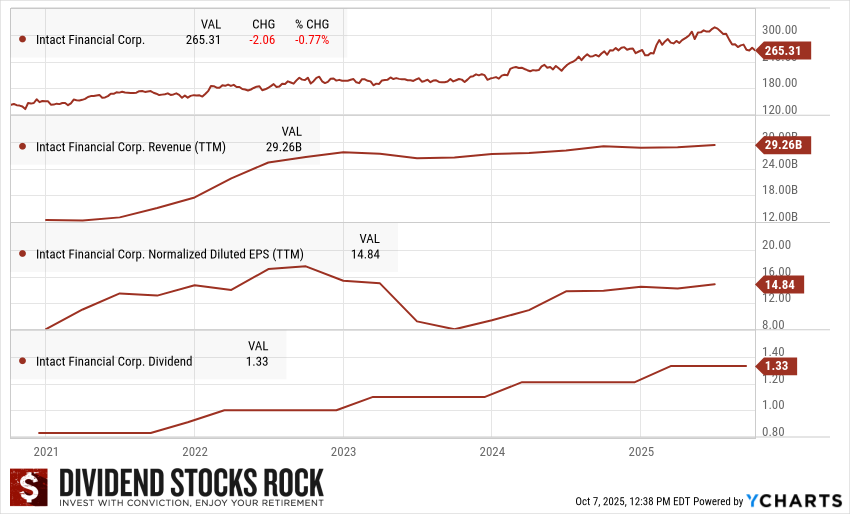
 Intact Financial Group (IFC.TO) 5-year Dividend Triangle Chart.
Intact Financial Group (IFC.TO) 5-year Dividend Triangle Chart.

Potential Risks

The biggest threat to Intact comes from nature itself. Catastrophe losses from floods and wildfires reached $1.5 billion in 2024, and the trend isn’t slowing. These unpredictable events make quarterly results volatile.

Additionally, insurance regulation—especially in auto insurance markets like Ontario—can cap pricing flexibility. In the U.S. and U.K., Intact faces fierce competition and integration challenges, especially as it scales its commercial footprint.

Despite these challenges, Intact’s data advantage and risk management culture keep it a step ahead of its peers.

Final Thoughts – The Pillars of Dividend Stability

Canadian insurance companies won’t be the most exciting holdings in your portfolio—but they might be among the most dependable. They bring balance when growth stocks stumble, and they keep cash flow rising even through recessions and market noise.

Here’s how they stack up:

  • Intact Financial – Best-in-class underwriting and risk management.
  • Sun Life – Diversified with strong asset management exposure.
  • Great-West Lifeco – A defensive dividend compounder.
  • Manulife – Global reach with a powerful growth engine in Asia.

Each of these insurers plays a different role, but together they demonstrate a straightforward truth: dividend growth thrives on financial discipline—and few sectors embody that better than Canadian insurance.

Find More Dividend Rock StarsRed star.

Want to discover more high-quality dividend growers like these?

Grab your copy of our Dividend Rock Star List, featuring around 300 stocks screened for dividend safety, growth potential, and long-term reliability.

Download your free Dividend Rock Star List here
A Steady Pace Toward Dividend Growth

Dividend investing is not about sprinting ahead—it’s more about maintaining a steady pace that delivers reliable results over time. Think of it like a marathon runner: disciplined, consistent, and built to withstand the test of endurance. Some businesses mirror that approach perfectly, combining stable cash flows with long-term strategies that enable dividends to continue growing. For investors seeking both income and peace of mind, this kind of stability can be just as rewarding as high-growth stories.

A Business Anchored in Protection and Wealth

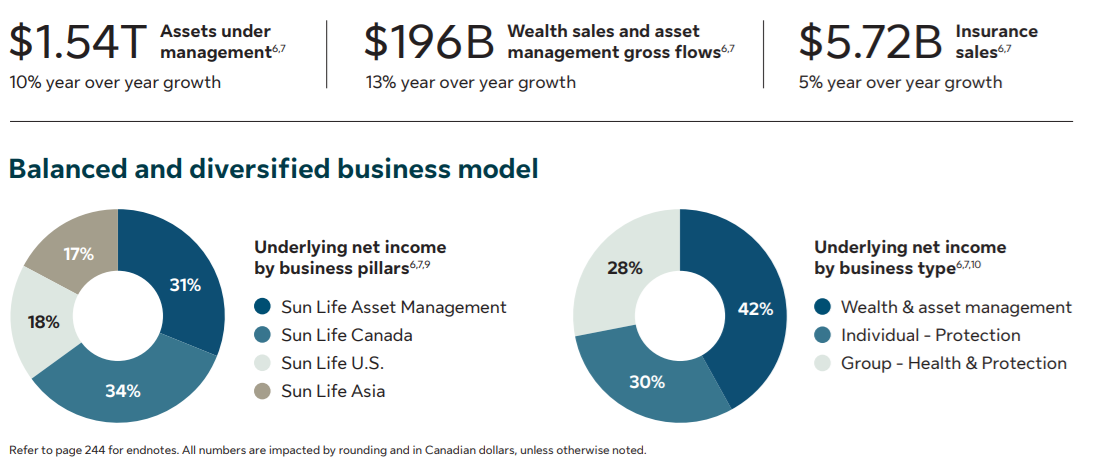
Sun Life (SLF.TO) operates across five key segments: Asset Management, Canada, U.S., Asia, and Corporate. Its business mix reflects three pillars:

  • Asset management & wealth – through MFS and SLC Management, which collectively oversee more than CAD 1 trillion in assets under management.

  • Group health & protection – providing benefits like dental, life, and disability insurance to employers and government programs.

  • Individual protection – traditional life and health insurance offerings sold directly to consumers.

In Canada, Sun Life dominates group insurance and retirement solutions. In the U.S., its acquisition of DentaQuest made it the #2 dental benefits provider. In Asia, it has tapped into high-growth markets where protection and wealth products are in demand. Together, these businesses create a diversified but competitive platform.

Sun Life Financial (SLF.TO) Financial Highlights and Business Model from its 2024 Annual Report.

Building Growth Beyond Insurance

The Bull Case

Sun Life is not just an insurance company anymore—it’s an asset manager, a group benefits leader, and an international operator. Roughly 42% of its earnings now come from asset and wealth management, offering stable, fee-based cash flows that buffer against insurance volatility.

  • Asset Management Powerhouse – MFS and SLC Management continue to scale. SLC has been expanding into alternatives, which command higher fees and offer growth potential even in volatile markets.

  • Group Benefits Leadership – In Canada, Sun Life’s group insurance footprint is unmatched, supporting recurring revenues tied to employer coverage. In the U.S., its DentaQuest acquisition broadened its reach, adding long-term growth potential.

  • Asian Expansion – Sun Life has reported record net income from Asia, where demand for protection products and wealth solutions remains high. This region is an essential long-term growth vector.

  • Tailwinds from Rates – Rising interest rates improve yields on Sun Life’s large fixed-income portfolio, directly benefiting investment income.

Demographics are also working in Sun Life’s favor. An aging population in North America is fueling demand for retirement planning and protection products, while middle-class growth in Asia supports wealth and insurance demand.

The Bear Case

Despite its diversification, Sun Life faces familiar industry headwinds. Insurance remains a commoditized business, where pricing—not brand—is the main competitive factor. Asset management, while profitable, is vulnerable to market downturns and investor outflows.

  • Interest Rate Sensitivity – Rising rates provide a short-term boost, but prolonged low-rate environments in the past have shown how thin insurance margins can get.

  • Market Exposure – With over CAD 1 trillion AUM, market corrections would directly hit Sun Life’s fee income. MFS already reported challenges from lower average assets.

  • Competitive Pressures – In insurance, Manulife and Great-West Life are fierce rivals in Canada, while global giants dominate in the U.S. and Asia. In asset management, Sun Life is a fraction of the size of BlackRock or Vanguard, making pricing pressure a constant risk.

  • Political and Regulatory Risks – Like all insurers, Sun Life must navigate evolving regulations, particularly in health and retirement products. Any policy shifts could alter profitability in key regions.

While the company has shifted away from struggling U.S. life insurance operations, it still depends on execution in newer markets to keep growth alive.

Free Webinar Invite: Avoid Price Confusion and Act with Conviction

When a stock dives or spikes, most investors focus on the price. That’s the wrong move. In this live session, I’ll show you how to ignore the noise and interrogate the business—so you can decide with confidence whether to sell, hold, or buy more.

New Webinar Invite
New Webinar Invite

Thursday, September 18th at 1:00 p.m. ET
~50 minutes + 1-hour Q&A
Replay available for all registrants
Seats are limited to the first 500

You’ll discover:

  • A simple framework to know when to ignore headlines and when to act

  • A quick business-model check that surfaces real risks (fast)

  • How to use the Dividend Triangle to separate bargains from traps

Save your spot (or get the replay)

What’s New: Record Earnings from Asia and Mixed Trends Elsewhere

Sun Life’s latest quarter (August 20, 2025) showcased both strengths and challenges:

  • Core EPS up 13.5% year-over-year.

  • Asset Management & Wealth delivered $455M in net income (flat).

  • Group Health & Protection rose 7% to $326M.

  • Individual Protection surged 110% to $299M, rebounding from softer prior-year results.

  • Asia posted record earnings on strong protection growth and higher wealth contributions.

  • U.S. Dental saw gains from Medicaid repricing.

  • Canada benefited from favorable group life mortality but softer individual protection.

Overall, the quarter confirmed Sun Life’s ability to grow earnings across multiple levers, but also highlighted its exposure to market-linked asset management results.

The Dividend Triangle in Action: Measured but Steady

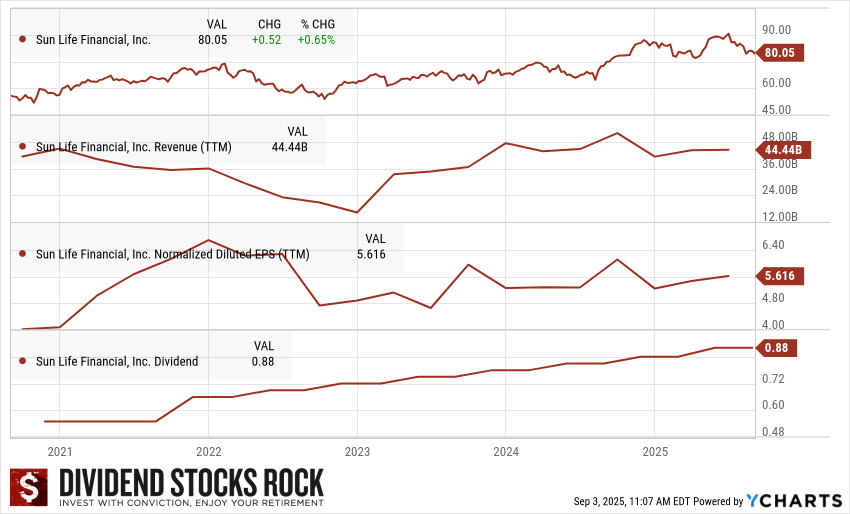
Sun Life Financial (SLF.TO) 5-year Dividend Triangle chart.

The dividend story at Sun Life is one of consistency rather than excitement. Revenue and EPS have climbed steadily, though not spectacularly, while the dividend has marched upward in tandem.

  • Revenue: Stable, with gradual growth supported by asset management and group benefits.

  • Earnings per Share (EPS): Lumpy due to market-linked businesses, but the long-term trend remains positive.

  • Dividend: A modest yield, but with dependable growth—management increased the dividend by 6% in 2025.

This is not a high-yield stock, but rather a dividend grower that can serve as part of a balanced portfolio.

Final Thoughts: Dividend Growth that Endures

Some businesses are built for endurance rather than speed. This one has proven it can steadily grow earnings, manage through cycles, and reward shareholders along the way. With its mix of insurance, wealth, and asset management, it may not consistently deliver fireworks. Still, it offers something even more valuable for dividend investors: the confidence that your income can continue to grow year after year.

Free Webinar: Avoid Price Confusion

Stocks often jump or drop 10% on earnings day. How do you know if it’s time to buy, sell, or simply hold?

Join me on Thursday, September 18th, at 1:00 p.m. ET for a free session where I’ll share how to cut through the noise, check the business fast, and use the Dividend Triangle to spot real opportunities.

Save your seat (or get the replay)

Copyright © 2025 · Moose Markets